“It is during our darkest moments that we must focus to see the light.” -Aristotle
“Let us not wallow in the valley of despair, I say to you today, my friends.
So even though we face the difficulties of today and tomorrow, I still have a dream. It is a dream deeply rooted in the American dream. I have a dream that one day this nation will rise up and live out the true meaning of its creed: We hold these truths to be self-evident, that all men are created equal.
I have a dream that one day on the red hills of Georgia, the sons of former slaves and the sons of former slave owners will be able to sit down together at the table of brotherhood.
I have a dream that one day even the state of Mississippi, a state sweltering with the heat of injustice, sweltering with the heat of oppression will be transformed into an oasis of freedom and justice.
I have a dream that my four little children will one day live in a nation where they will not be judged by the color of their skin but by the content of their character. I have a dream today.
I have a dream that one day down in Alabama with its vicious racists, with its governor having his lips dripping with the words of interposition and nullification, one day right down in Alabama little Black boys and Black girls will be able to join hands with little white boys and white girls as sisters and brothers. I have a dream today.
I have a dream that one day every valley shall be exalted, every hill and mountain shall be made low, the rough places will be made plain, and the crooked places will be made straight, and the glory of the Lord shall be revealed, and all flesh shall see it together.” -excerpt from Dr. Martin Luther King Jr’s “I Have A Dream”, speech delivered on Aug. 28, 1963, on the steps of the Lincoln Memorial
How does a dream become a reality?
First you dream it.
Next, you express it out loud. Consistently, confidently and passionately. To anyone and everyone who will listen.
Then you set out to do it. Along with the others who believe in you and your dream.
And you keep doing it, and doing it, and doing it. No matter how long the odds, no matter how dim the light, no matter how difficult the struggle.
Until it gets done.
Until the dream becomes a reality.
P.S. – Happy birthday. (The full transcript of Dr. King’s incredible speech can be read and listened to here.)
“The lack of a singular hero in the face of this disaster is not something to fret — only our desire for one is. Even though some claimed to be such heroes around the other disasters we’ve faced, I find they were more like the movies we make – they were acting a role. They were fulfilling our fantasies. We need and want something different now than individual heroes.
My fantasy is that now together we start to step out of our illusion. The truth is there will be no hero to save us.
There will only be each other. There will only ever be each other.
It is time we stop motivating everything to allow only one person to wear the cape. The heroes are the community. The community shall rise. It is by working together that things get built back better. There are no small actions. Each little improvement we make demonstrates our abilities to make a difference. When we look at all of these and take them together, we see teamwork.
Sometimes we lead. Sometimes we support. Each time and with each action, we are lending a hand. We are reaching out. We find a path and build it so others too can walk forward.” -Ted Hope
“The only solution is love and that love comes with community.” -Dorothy Day
“My grandfather was the first sage warrior I knew…Papa Ji tied his turban every day, clasped his hands behind his back, and surveyed the world through the eyes of wonder. When he listened to kirtan, sacred music, he closed his eyes and let the music resound wondrously within him; he wrote poetry in his garden…As I fell asleep each night, Papa Ji would sing the Mool Mantr, the foundational verse that opens the Guru Granth Sahib, our sacred canon of musical wisdom. It begins with the utterance “Ik Onkar,” which means Oneness, ever-unfolding. “All of Sikh wisdom flows from here,” Papa Ji would say. All of us are part of the One. Separateness is an illusion: There is no essential separateness between you and me, you and other people, you and other species, or you and the trees. You can look at anyone or anything and say: You are a part of me I do not yet know.” -Valarie Kaur, Sikh activist and author of Sage Warrior: Wake to Oneness, Practice Pleasure, Choose Courage, Become Victory
Depending on the situation, your circumstance and your strengths…Perhaps you lead. Perhaps you follow. Perhaps you do both.
But either way, no one ever does it alone.
We do it together. With each other. For each other. Because we only have each other.
We are one.
P.S. – This inspiring news story of nonprofit groups partnering to transform a downtown LA arts hub into temporary housing for fire victims.
P.P.S. – For more of the interview with Valarie Kaur including a brief story of Guru Nanak, founder of the Sikh faith, click Here.
Not-knowing is true knowledge. Presuming to know is a disease. First realize that you are sick; then you can move toward health.
When they think that they know the answers, people are difficult to guide. When they know that they don’t know, people can find their own way. -Lao Tzu, Tao Te Ching (Stephen Mitchell translation)
“Inspiration is not the exclusive privilege of poets or artists generally. There is, has been, and will always be a certain group of people whom inspiration visits. It’s made up of all those who’ve consciously chosen their calling and do their job with love and imagination. It may include doctors, teachers, gardeners – and I could list a hundred more professions. Their work becomes one continuous adventure as long as they manage to keep discovering new challenges in it. Difficulties and setbacks never quell their curiosity. A swarm of new questions emerges from every problem they solve. Whatever inspiration is, it’s born from a continuous “I don’t know.”
This is why I value that little phrase “I don’t know” so highly. It’s small, but it flies on mighty wings. It expands our lives to include the spaces within us as well as those outer expanses in which our tiny Earth hangs suspended. If Isaac Newton had never said to himself “I don’t know,” the apples in his little orchard might have dropped to the ground like hailstones and at best he would have stooped to pick them up and gobble them with gusto.
Had my compatriot Marie Sklodowska-Curie never said to herself “I don’t know”, she probably would have wound up teaching chemistry at some private high school for young ladies from good families, and would have ended her days performing this otherwise perfectly respectable job. But she kept on saying “I don’t know,” and these words led her, not just once but twice, to Stockholm, where restless, questing spirits are occasionally rewarded with the Nobel Prize.
Poets, if they’re genuine, must also keep repeating “I don’t know.” Each poem marks an effort to answer this statement, but as soon as the final period hits the page, the poet begins to hesitate, starts to realize that this particular answer was pure makeshift that’s absolutely inadequate to boot. So the poets keep on trying, and sooner or later the consecutive results of their self-dissatisfaction are clipped together with a giant paperclip by literary historians and called their “oeuvre.” -Polish poet Wislawa Szymborska, excerpt from her Nobel Prize acceptance speech in 1996
“As for me, all I know is that I know nothing.” -Socrates
“In the end is my beginning.” -T.S. Eliot, poem Four Quartets
“I Don’t Know” is brave, honest, vulnerable and empowering. Continuously say it.
At the Start (when you have no idea if it will work or how you will get through it): “I Don’t Know.”
During the Middle (regardless if you’re making progress or not): “I Don’t Know.”
In the End (after you’ve solved it or completed your project): “I Don’t Know.”
The continuous “I Don’t Know” allows you to always have beginner’s mind, and an open eye and heart. It keeps things fresh, thereby inspiring you for the next project, problem or artistic endeavor you wish to tackle.
P.S. – Hat tip to the always excellent Poetic Outlaws Substack for the Nobel speech by Wislawa Szymborska. You can read it in its entirety Here.
P.P.S. – Speaking of remarkable Polish women and the Nobel Prize…Marie Curie is the first woman to win a Nobel, the first person to win it twice, and the only person to win it for two different scientific fields. For a great Marginalian article on Marie Curie, click Here. And read the poem Power by Adrienne Rich here.
“So, what is hope, and what is hope for? Hope is an emotional temper that emboldens the heart to be active, it is a condition, a mood, an aura of being. It is a feat of the imagination, both courageous and ingenious, a vitality that inspires us to take innovative action to defend the world. Hope is essential to our survival and our flourishing.
We achieve this vitality of spirit by rejecting the relentless promotion of despair and opening our eyes to the beauty of things, however imperilled, degraded, or difficult to love the world may appear to be. We try to view the world not as it is packaged, presented and sold to us but as we imagine it could be. We do not look away from the world, we look directly at it and allow the spirit of hope – the necessary driver of change — to inspire us to action.” -Nick Cave, The Red Hand Files
“Alone, we can do so little; together, we can do so much.” -Helen Keller
Join us tonight, January 14th, at 6:30pm PT for a special Vs. Tuesday Night Zoom. It’s a chance for everyone affected by these wildfires (directly and indirectly) to share, to grieve, to uplift and to hold space together. It’s also an opportunity for us all to explore and strategize the most efficacious ways to help those in need.
If you’re not already on the Vs. readings email list, but want to join tonight’s Zoom, drop me a line (jclark@vstheatre.org) and I’ll forward you all the info.
If you can’t join tonight but have ideas or links you’d like me to share with the group, drop me a line and I will do so.
Stay safe out there there. We’ll get through this. Together.
P.S. – For a good list of resources and ways to help, click Here. (h/t to Arts For LA for providing)
“If you are genetically endowed with an optimistic bias, you hardly need to be told that you are a lucky person—you already feel fortunate. An optimistic attitude is largely inherited, and it is part of a general disposition for well-being, which may also include a preference for seeing the bright side of everything. If you were allowed one wish for your child, seriously consider wishing him or her optimism. Optimists are normally cheerful and happy, and therefore popular; they are resilient in adapting to failures and hardships, their chances of clinical depression are reduced, their immune system is stronger, they take better care of their health, they feel healthier than others and are in fact likely to live longer. -Daniel Kahneman, Thinking, Fast and Slow
“You must never confuse faith that you will prevail in the end — which you can never afford to lose — with the discipline to confront the most brutal facts of your current reality, whatever they might be.” -Jim Stockdale (Medal of Honor winner who spent 8 years as a P.OW. in Vietnam)
“Hope” is the thing with feathers – That perches in the soul – And sings the tune without the words – And never stops – at all –
And sweetest – in the Gale – is heard – And sore must be the storm – That could abash the little Bird That kept so many warm –
I’ve heard it in the chillest land – And on the strangest Sea – Yet – never – in Extremity, It asked a crumb – of me. -poem “Hope is the thing with feathers” by Emily Dickinson
Optimism is great, but it’s not enough. For those really difficult and uncertain times, when circumstances are brutal, when you don’t know if you’re gonna make it through, when you don’t see any light in the distance, when you can’t possibly fathom how this story ends well, enter hope.
Hope is mysterious and mystical. Hope is relational. It’s trust in one another and something much bigger and more powerful than just yourself and your optimistic mindset.
You don’t need to know how or when you will get through this. You just need to know and have constant hope that you will.
That hope and trust is what allows you to take the necessary steps and actions to just get through this minute, this hour, this day. And to help each other do the same.
Well I don’t know about your right and wrong I got a muse from the east to the west All I know is if I never said it before I’m going to say it with my last breath
I will never forget your healing hands my love I thought my heart had stopped I swore I had given up I will never forget your healing hands my love You gave me daylight you gave me sunlight -song “Healing Hands” by Citizen Cope
It’s been incredibly heartwarming to see Angelenos coming together to help one another during these fires. I thought to share a beautiful story about the power of art, brotherhood and radical generosity. (Courtesy of George Bothamley and his always excellent “Art Every Day” Substack, I’ve cut and paste it below. You can also read it directly on his site Here. )
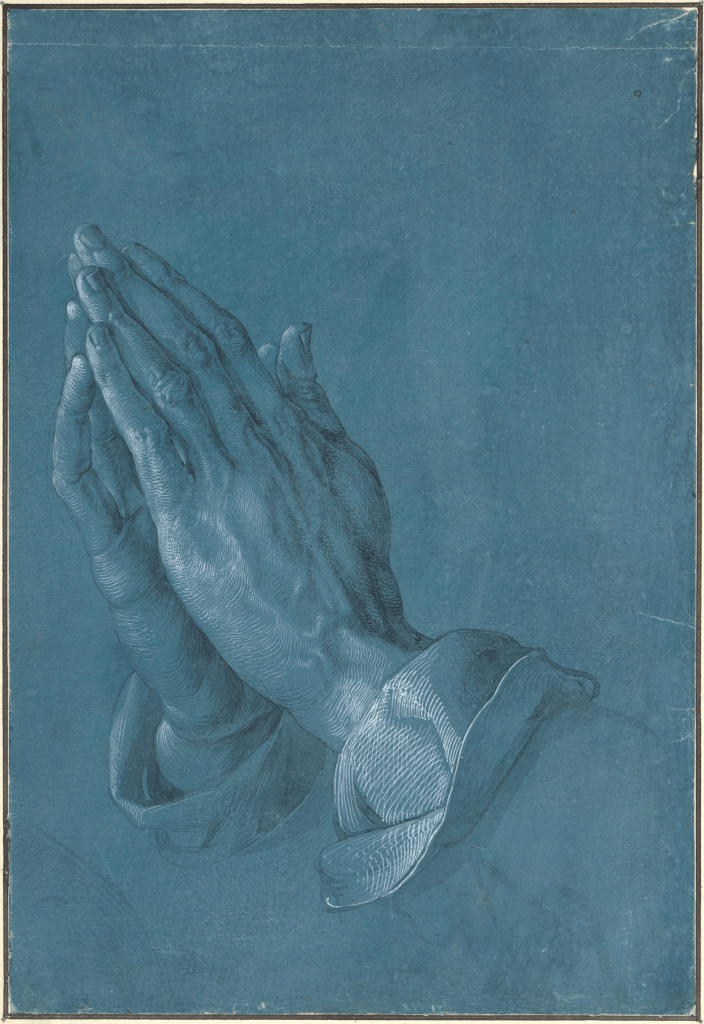
For a long time, Albrecht Dürer’s drawing of these praying hands was interpreted as being kind of self portrait – i.e the artist seems to be depicting his own hands as a symbol of both his spiritual and artistic devotion.
But, actually, the truth about this picture is that the hands actually belong to the artist’s brother – Albert Dürer
And for the real story behind its deeper meaning, we need to briefly go back to when the two brothers were growing up in poverty together; in a small town just outside of Nuremberg.
Albert was the eldest of the two brothers, but they were always very close; and in sharing a mutual love of art, they would spend many happy days together making drawings, or dreaming of becoming professional painters when they grew up.
Back then, the artistic talent in both young boys was undeniable – so, had they been born into a wealthier family, there would have been no question that the two of them would have been sent off to study together in an academy, or for a joint apprenticeship under a master painter in Nuremberg.
But, sadly, the Dürer family were struggling financially at this time due to Albrecht the elder’s business as a goldsmith taking a bit of a down turn.
And in the 15th century – much like now – being an artist was not always the most lucrative field to go into.
So, when the brothers were on the cusp of coming of age, they settled on a little agreement together.
They knew that it could be possible for at least one of them to go on to study art professionally, as long as the other stayed behind to take care of the family.
Thus, in an attempt at the fairest possible way of making this decision, they put their future fate on a coin toss.
Heads for Albert – Tails for Albrecht.
In other words, if the coin landed on heads – then Albert would go off to pursue artistic training in Nuremburg; and the younger Albrecht would instead take a job as a labourer in the local mine, to support to family.
And if it landed on tails . . . then roles would be reversed. Albrecht would go to Nuremburg – Albert would stay behind.
The coin was tossed – and it was the younger brother who came out as the luckier of the two.
Thus, only a few weeks later, Albrecht Dürer was on his way to the city, with a letter of recommendation to become an artist apprentice. And Albert, just as he promised, stayed in the family home . . . taking a job in the local coal mine.
A few years passed – and clearly the result of the brother’s coin toss paid off.
Albert’s work was physically exhausting – but it helped keep the family above the poverty line until business picked up again.
And Albrecht excelled so much in his painting apprenticeship, that he found himself rather unexpectedly set en-route to becoming the most sought after artists in all of Germany.
At only 21 years old – soon after painting the portrait seen below- the young man returned to his home town like a celebrity. But, of course, Albrecht still carried with him a certain amount of guilt about all his success too.
He was deeply aware of just how much of a sacrifice his brother had made for him. And he couldn’t escape the thought that, if a simply coin toss had gone a different way, all of this success would have been Albert’s instead.
So, one evening – when the two brothers finally had some alone time together at their family home – Albrecht said to his brother
“Brother, listen to me. You’ve sacrificed so much for all of us . . . isn’t it time you followed your dream too? You know, I am earning well now. I can provide for everyone quite comfortably. And you don’t have to go back down to those mines anymore. Come with me . . . come to Nuremberg! I’ll help you get started as a painter – and we’ll achieve what we both dreamt about all those years ago together. You will create marvellous things, I’m sure of it!”
But- in spite of his deep gratitude for all that had been said – sadly, Albert could not share his brother’s enthusiasm
“No.” he said “It is not possible. My time has gone now.Albrecht, look at these hands of mine. You see the fingers? In these few years of work, I have broken all of them – multiple times. And you see these scars? These lumps? These marks where my hands have been beaten, bruised, calloused, and crushed by so much stone. You know . . . I can hardly even hold a knife and fork delicately when I eat, such is my loss of feeling in these hands now. So how could I ever hold a paintbrush or pencil?! No, brother. For me . . . it is too late.”
Then, letting go of his brother once more, Albert brought his broken hands together in prayer – saying
“Come. Let’s just pray together – as we used to when we were children. We should be grateful that you have achieved enough for both of us!”
And clearly, this moment is one that Albrecht would never forget; because it is the very thing he captures in his most famous drawing here – sketched over a decade later, when the two brothers were in their mid to late thirties
Technically, it was designed as a “preparatory” sketch for a larger altarpiece commission that the artist was working on at the time (now destroyed).
But in all the tenderness and painstaking care taken over the work here – we can see that, for Albrecht, this drawing is so much more than just a study of hands.
In truth, it is an expression of gratitude instead ; paying tribute to his brother’s sacrifice.
And for that reason, the underlying message of this work is that Albrecht Dürer may have been the artist in practice . . . but nonetheless, his entire career was in fact the result of his brother Albert’s hands too!
This doesn’t just apply to “artists” or making “art”, but to anyone who feels a calling inside and wants to help.
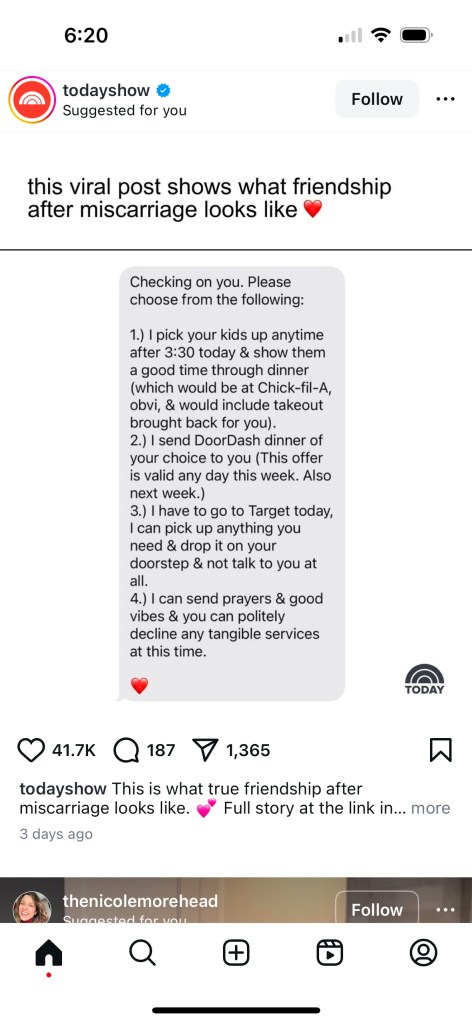
A little while back my wife sent me this beautiful post about friendship:
When people are going through a particularly difficult time, they often (a) don’t reach out for help and/or (b) are so overwhelmed, they can’t think specifically about what they might need. They need everything. And you can help them by doing the thinking for them. Even if, and this is key, what you think they might need “might not work.” That’s the “art” of your generosity.
These fires are a chance to reach out to anyone we know who has lost their home. Inspired by the above IG post, we might right each to them with a short text and put together a numbered list of specific ways we can help. Including providing the option to decline our offer and just pray for them. As what they might need most right now, is just time and space to process coupled with the knowledge you are there for them.
P.S. – If you’re wanting to help those affected by the fires, this LA Times article provides an updated list of resources and things you can do. Stay safe out there everyone. Take good care of yourselves and each other. We will get through it.
“The bamboo that bends is stronger than the oak that resists.” -Japanese Proverb
“We cannot choose our external circumstances, but we can always choose how we respond to them.” -Epictetus
“Nothing is softer or more flexible than water, yet nothing can resist it.” -Lao Tzu
When a crisis or emergency happens, it’s not about anticipating every single problem that could’ve happened with one hundred percent accuracy. That’s impossible. (Though some preparation is always a good thing.)
Far more important, and within your control, is having a flexible mindset to deal with circumstance. Something happens and you quickly have to make a decision. A new thing happens and you have to make a brand new decision. And so on and so forth.
Until the crisis is over.
When it is over, that’s the time to go back and evaluate your decisions. Learn from them and perhaps be a little better prepared for the next one.
But no matter this event or future events, it is your flexible mindset that will get you through it. And you will get through it.
P.S. – Thank you to all those who’ve checked in on us during the fires. It means a lot. Our bags are packed and we’re ready to go at a moment’s notice. But we’re okay and I hope and pray you are too. My heart and prayers go out to all those who have lost homes and been affected by this terrible tragedy.
“The chief task in life is simply this: to identify and separate matters so that I can say clearly to myself which are externals not under my control, and which have to do with the choices I actually control. Where then do I look for good and evil? Not to uncontrollable externals, but within myself to the choices that are my own.” -Epictetus, Discourses
“God, grant me the serenity to accept the things I cannot change, the courage to change the things I can, and the wisdom to know the difference.” -Serenity Prayer
“You have power over your mind, not outside events. Realize this and you will find strength.” -Marcus Aurelius, Meditations
“The following little reminder sums up the three most essential parts of Stoic philosophy worth carrying with you every day, into every decision:
Control your perceptions. Direct your actions properly. Willingly accept what’s outside your control. That’s all we need to do.” –The Daily Stoic: 366 Meditations on Wisdom, Perseverance, and the Art of Living by Ryan Holiday, Stephen Hanselman
So much of Stoicism is about identifying what is in and out of our control. This not only applies to the events of our lives (reactive), but also to the goals we set for ourselves (proactive).
A good practice is after you set your goals or intentions, immediately ask yourself which are within your control and which are out of your control.
Two examples that might help clarify this point:
(1) You set a goal to win an Academy Award for Best Actor.
Awesome. Nothing wrong with big goals and dreams. Go for it! Just realize this one is not in your control. It is dependent on external forces.
(2) You set a goal to become the best actor you can be.
This one is within your control. You can study, train, observe, read, watch, perform, self-produce, etc…Over the course of a year, two, five, ten, a lifetime…you will inevitably get better and better and “become the best actor you can be.”
Again, there is room for both kinds of goals. Just be aware of the difference. (Another way to differentiate is Stretch vs. SMART goals.)
Oh and by the way, as a result of focusing on your in control goal of “becoming the best actor you can be”, you might just get the out of control goal of “winning the Academy Award” thrown in for free.