No matter how great your art, your product, you public policy, your generous act, your thoughtful suggestion, etc…you can rest assured, at least half the people won’t like or agree with it.
That’s ok. It’s not for them.
If you need a statistical goal to shoot for and feel like you’ve succeeded in your chosen endavour, aim for 51 percent.
While that gets you an F in school, for most things in life, it’s an A.
“He felt an uncertainty in the air, a feeling of change and of loss and of the gain of new and unfamiliar things.” –The Red Pony by John Steinbeck
There’s an age old story about optimists and pessimists which goes something like this…
It’s Christmas morning and two young brothers rush towards the Christmas tree to discover their gifts. On one side lay piles of wonderful toys for one of the boys. The boy does nothing. He just looks at the pile and says, “What’s the point? They’ll all be broken in a day or two.“
The other boy’s gift, on the other side of the tree, is nothing but a pile of manure. The boy quickly starts digging through the manure. He digs and digs and digs, all the while joyfully telling his dour sibling, “There must be a pony in here somewhere!”
Events are events. You don’t get to control them.
Your attitude about those events however, is entirely up to you. You get huge control over that.
So what’s it gonna be?…Will you keep searching for the pony?…Or give up before you even start?…You decide.
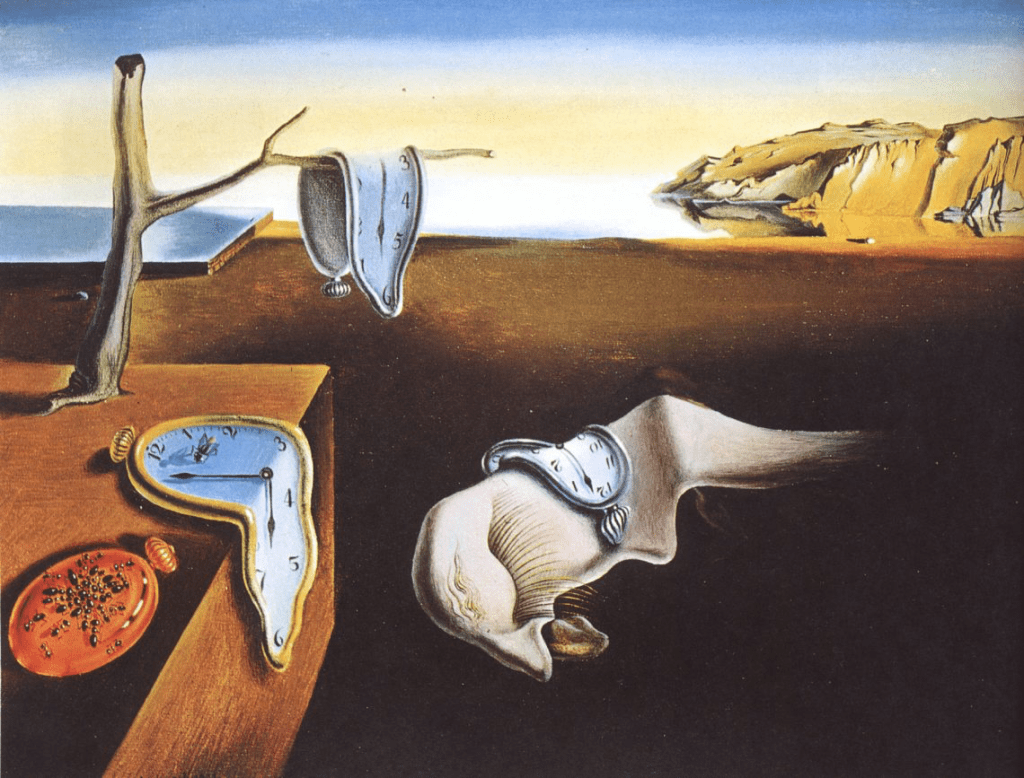
“At the age of six years, I amazed my parents and their friends by my gift, very much of the sort that mediums have, of ‘seeing things in another way’. I have always seen what others do not see; and what they did see, I could not…I had a paranoiac spirit.” -Salvador Dali
“In 1851, Melville calved an enormous spouting beast of a book, Moby-Dick, which involved a crazed sea captain hell-bent on destroying the whale that tore off his leg. The book sold poorly. After two more failed novels, Melville, a father of four, ditched prose for poetry, grew ever more melancholic and insolvent, and became a customs inspector on the New York docks, a job he held for nineteen years. His death in 1891 went virtually unnoticed…’Melville was a nineteenth-century author writing for a twentieth-century audience,” explains Columbia professor Andrew Delbanco, author of the 2005 biography Melville: His World and Work. ‘He used stream of consciousness long before Stein or Joyce; he acknowledged America’s predatory power as well as its great promise; he defied convention in writing about sex; and perhaps most shocking of all, he took seriously the possibility of a godless universe. In his time, there was a limited market for these insights and innovations.” -excerpt from article, How Scholars Rescued the Author of Moby-Dick from the Waters of Oblivion in Columbia Magazine
“If you see tremendous beauty or tremendous pain where other people see little or nothing at all, you’re confronted with big feelings all the time. These emotions can be confusing and overwhelming. When those around you don’t see what you see and feel what you feel, this can lead to a sense of isolation and a general feeling of not belonging, of otherness. These charged emotions, powerful when expressed in the work, are the same dark clouds that beg to be numbed to allow sleep or to get out of bed and face the day in the morning. It’s a blessing and a curse.” -Rick Rubin, The Creative Act
Artists see things before anyone else does. Whether that’s making art ahead of its time, or art that influences science and other fields (like Salvador Dali did as this article points out), or setting trends (e.g. fashion, neighborhoods), or being prophets that call out injustice and hypocrisy, artists very often lead the way.
Unfortunately, this gift of “seeing” can come with a heavy burden and price. You can be ignored, criticized or feel like a failure.
But don’t let that stop you.
Our world needs artists now more than ever.
Go make your art.
Go lead the way.
Thank you for your courage and your heart and your vulnerability.
“When I let go of what I am, I become what I might be.” -Lao Tzu
For any journey you’re on–let’s say climbing a mountain–to get to the next level, you do have to let go of your current (often a comfortable and safe) spot.
Bilbo had to leave the Shire too.
P.S. – When you read the Lao Tzu quote above, what comes to mind for you? Let me know your thoughts!
“Every scene is filled with discoveries, things that happen for the first time. No matter how many times it has happened in the past, there is something new about this experience, this moment. Each of the many scenes between the constantly bickering George and Martha in WHO’S AFRAID OF VIRGINIA WOOLF would be boring and tiresome if the actors did not find what is new, what is different, what is particularly at stake in the scene. Acting is a whole series of discoveries.
The discoveries may be about the other character, or about oneself, or about someone who is offstage, or about the situation now or the situation as it existed ten years ago and how that affects the now. The more discoveries you make in a scene—the less you rely on “we do this every day”—the more interesting your scene will be. It’s hard to bring vitality and life to routine, but they are difficult to escape when you have the excitement of discoveries. Take nothing for granted; make an emotional discovery as often as you can find one in every scene. Ask yourself: What is new?” –Audition: Everything an Actor Needs to Know to Get the Part by Michael Shurtleff
For the actor…
A big tool in your arsenal for making it feel like the first time, is discovery. Everywhere in the text, find moments where your character can be surprised. The more you dig, the more discoveries you will unearth.
And a way to activate discovery, especially in auditions or early in the rehearsal process, is to make a slightly audible “Oh!” at each one. (Thanks to my friend and wonderful actor/teacher Kurt Naebig, for this tip.) You can drop the “Oh!” later on, but the sense of discovery will stay with you. Kinda like muscle memory.
(And if it’s a negative discovery, feel free to substitute an “Oh!” with a “D’oh!.” Equally effective. 🙂
The audience loves to watch characters discover. Just like when you’re interested, we’re interested, when you’re surprised, we’re surprised. Which in turn, brings us joy and keeps us engaged.
And it feels like the first time Like it never did before Feels like the first time Like we’ve opened up the door Feels like the first time Like it never will again Never again
[Chorus] (Feels like the first time) It feels like the first time (It feels like the very first time) Very first, feels (It feels like the first time) Oh, it feels like the first time (Feels like the very first time) -song, “Feels Like The First Time” by Foreigner
“Wandering about saying the lines over and over and over and over so that you can eventually give an impression of spontaneity. That’s the job.” -Bill Nighy
For the actor…
No one ever forgets their first time. Including the audience.
You must act as if you’re saying and hearing these lines for the very first time. Besides being the strongest and most vulnerable choice, it’s the craft. It’s the job.
The audience paid good money and sacrificed considerable time to come see this exciting story get told. To watch you make huge discoveries in the process.
“Faith is to believe what you do not see; the reward of this faith is to see what you believe.” -Saint Augustine
I believe, I believe in you You believe in me too -lyrics from song “I Believe In You” by Johnnie Taylor
“I believe in you.”
Behind many a success story, is someone who believed in that person early on. Like Denzel Washington talks about here. And Alex Rodriguez talks about here.
The greatest gift you can give another person is to believe in them. Especially when they don’t yet believe in themselves.
The next time someone is brave enough to share with you their deepest desires, look them squarely in the eye and tell them. “I believe in you.” And mean it with all your whole heart and soul.
Be the company (or organization or group or person) that when the industry’s in chaos, people still say, “Yeah…But there is this one (insert name)…that’s thriving. I love what they do and how they go about doing it. They give me hope.”
“How many things I do when the soul, in so much spiritual and material need, turns to me, looks at me and says to me, “You take care of it”, then closes its eyes and rests. In pain you pray for me to act, but that I act in the way you want. You do not turn to me, instead, you want me to adapt your ideas. You are not sick people who ask the doctor to cure you, but rather sick people who tell the doctor how to.” -Fr. Don Dolindo’s Surrender Novena
“We all develop characteristic patterns of acting and thinking, and such patterns exist because it serves a function. The time for change comes when we realize that the same function could be served in a better way.” –The Inner Game Of Tennis by Timothy Gallwey
“Throw out your conceited opinions, for it is impossible for a person to begin to learn what he thinks he already knows.” -Epictetus, Discourses
Do you want affirmation? Or thoughtful and critical feedback?
Do you want to stay comfortable and complacent? Or do the sometimes uncomfortable work, of getting better?
Do you want to remain fixed in your ideas and skillset? Or are you open to learn new things?
Do you want to be healed? Or tell the physician how to do their job?
The first step is being honest in what you want.
If it’s to grow and get better, then the second step is to be open, humble and surrender.
Let go.
When you do, that’s when the exciting change can happen.
I celebrate myself, And what I assume you shall assume, For every atom belonging to me as good belongs to you…
In all people I see myself, none more and not one a barley-corn less, and the good or bad I say of myself I say of them…
Do I contradict myself? Very well then I contradict myself, (I am large, I contain multitudes.) -Excerpts from poem, Song Of Myself by Walt Whitman
“Recognize that the very molecules that make up your body, the atoms that construct the molecules, are traceable to the crucibles that were once the centers of high mass stars that exploded their chemically rich guts into the galaxy, enriching pristine gas clouds with the chemistry of life. So that we are all connected to each other biologically, to the earth chemically and to the rest of the universe atomically. That’s kinda cool! That makes me smile and I actually feel quite large at the end of that. It’s not that we are better than the universe, we are part of the universe. We are in the universe and the universe is in us.” -Neil deGrasse Tyson
Be content with what you have; rejoice in the way things are. When you realize there is nothing lacking, the whole world belongs to you. –Tao Te Ching by Lao-Tzu (Stephen Mitchell translation)