
March 2025 Favorites

In addition to recapping my end of year favorites (films, plays, books, albums, etc.) I thought for 2025, I’d share each month. Without further adieu and in no particular order, here are March faves…

FILMS:

The China Syndrome directed by James Bridges – I’ve watched this one multiple times now and each time I appreciate it more and find something new. Besides the gripping plot, it features dynamite performances across the board including Jane Fonda, Jack Lemmon and Michael Douglas. Lemmon gives a clinic in behavior and vulnerability.

Three Films by Joan Micklin Silver – Thank you Criterion Channel for curating her work. Silver was a trailblazer, one of only a handful of women to direct a film for a major Hollywood studio in the 1970s, and the three films below are fantastic and beautifully showcase her range and talent. You can read more about Silver and her work in this Criterion essay.

Chilly Scenes Of Winter – John Heard gives an incredible performance.

Between The Lines – Very early Jeff Goldbum performance. He and the entire ensemble are great.

Crossing Delancey – The look on Amy Irving’s face when she sees the Pickle Man at his work (played by Peter Riegert) is worth the watch alone.

PLAYS (Live, In Person):

The Unraveling conceived and directed by Katherine Noon – A phenomenal World Premiere from Ghost Road Company. The entire ensemble was incredible and fiercely committed throughout. No moment was taken for granted. And the production design had so many great and memorable takeaway moments. Thrilled to have done a Vs. Theatre Club outing for this one.

Unreconciled written and performed by Jay Sefton – Another Vs. Theatre Club outing, featuring a one person tour de force from Jay Sefton. His character work was so specific and spot on. You felt as if you were in the same room with all these people. Jay boldly tells his truth, and in doing so, it’s not just cathartic for him, but also for all of us, who are privileged to witness.

Barrymore written by William Luce – Another Vs. Theatre Club outing and another tour de force performance from Vito D’Ambrosio. Don’t miss its return engagement at the Whitefire Theatre in May.

ALBUMS:

The Clash – “Combat Rock”

Purple Mountains – “Purple Mountains” – The lyrics are haunting–especially when you read about the struggles and what happened to David Berman shortly after releasing the album–but the melodies are surprisingly upbeat and uplifting. This dynamic contrast makes this album a masterpiece and a must listen and re-listen. (H/t to my friend Ron for turning me on to this one.)
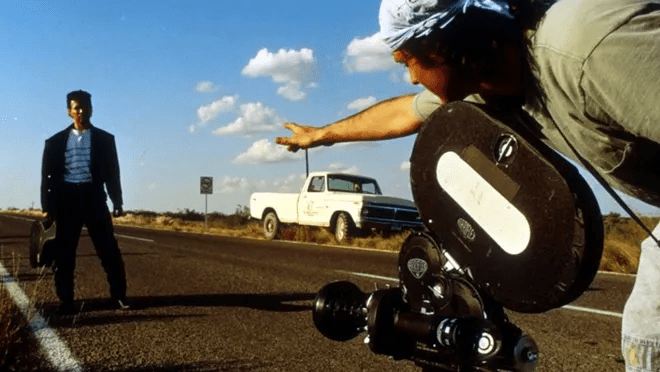
Give Your Ego A Break

Give your ego a break.

YOU didn’t make it.

Instead you got out of the way and let it happen.

That’s the secret. (Put you do have to sit down at the desk and pick up the pen.)

Listen to this phenomenal podcast interview with Robert Rodriguez. It’s quite possibly the most inspiring and greatest lesson on creativity you will ever hear in your life. (H/t to my friend Ron for bringing it to my attention.)

“Age Quod Agis”

“Age Quod Agis” is a Latin phrase that translates to “Do what you are doing” or “Concentrate on the task at hand.” It’s attributed to Ignatius of Loyola, founder of the Jesuit Order.

It’s a wonderful reminder to simply be present and not take any single task for granted. If you’re brushing your teeth, brush your teeth. If you’re washing the dishes, wash the dishes. If you’re writing the email, write the email. If you’re acting on stage, concentrate fully on your single action or single behavior.

We’re all human. We’re all busy. We all get distracted. Even professional athletes drop the ball because they’re thinking ahead to the next play.

It’s okay. Just pause. Bring your attention back on what you’re doing. If need be, think or say to yourself outloud “What am I actually doing right now?”

Then repeat as a mantra:

“Age Quod Agis.”

Strive to have your day be filled up with as many concentrated tasks as possible.

You’ll be a lot more effective and whole lot happier in the process.

Failure and Archery

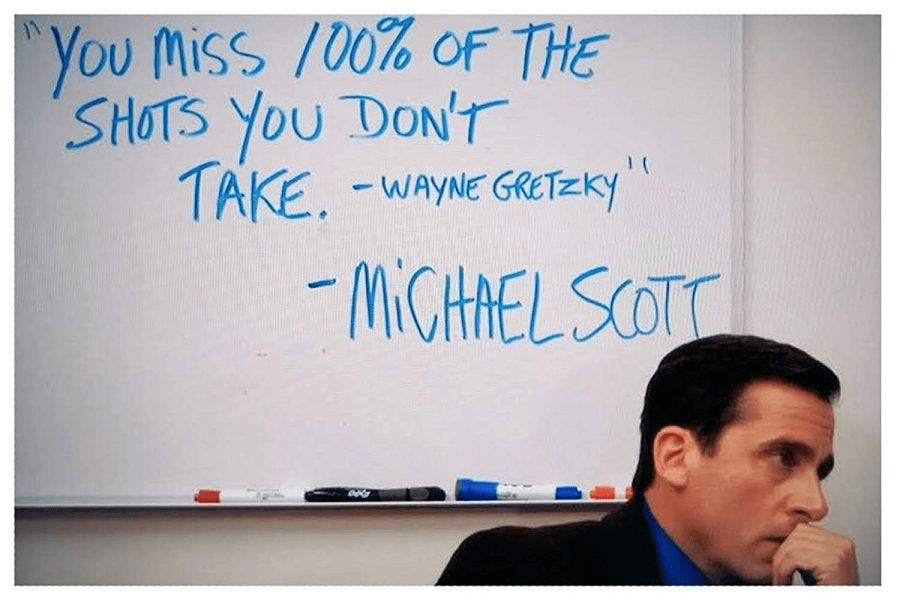
More failure = More opportunity (to learn, to grow, to improve, to accept responsibility) = More success and fulfillment.

Fail more.

Q & A: “Should I Do It?”

Question: “Should I do it?”

Answer: “If you can be talked out of it, then you shouldn’t do it.”

Get Some Sh-t Done

The joy you feel from accomplishing something is the same whether you had to do it or wanted to do it.

So, wanna feel good today?

Stop hesitating. Just complete something. Anything. Go get some sh-t done.

MASTERpiece

Leonardo da Vinci – The Last Supper – 1495-1498

If you’re working with a master whose aim is a masterpiece, then you have to constantly remind yourself that in terms of completion, “it takes what it takes.”

Read this post from George Bothamley and his always excellent Art Every Day Substack about Ludovico Sforza (The Duke of Milan) commissioning Leonardo for this now famous fresco painting.

From the post…

Sometimes, he would paint non stop, for hours on end – perhaps even turning up in the middle of the night to “correct” some minor detail in a work that was still not even fully sketched out.

Other times, he was known to go missing for days or weeks at a time – with no word of when he would return to the painting.

And then, when he was finally on site again, the brothers would often spy on him just standing in front of the work . . . lost in a world of his own, until eventually he might deign to lay a single brushstroke, before leaving again.

If you were tasked with producing this work, how would you handle Leonardo? And would you have the patience to see it through to completion?

Impressing

The people you are trying to impress…why exactly are you trying to impress them again? And what would it feel like to not care about impressing anyone, ever again?

Awareness is the key.

Carry on.

Desperately Wanting and Pursuing

For the actor…

Deep down, everyone desperately wants something.

Few have clarity over what that is.

And, setting opportunity aside, even fewer have the courage and discipline to go after it.

But on stage (or screen), we want to watch people–heroes and villains alike–who know what they want and pursue it at all costs.

(Even Hamlet desperately wants something. He just keeps changing his mind about what exactly that is.)

Besides knowing your lines forwards and backwards/exactly as written, you must know what you desperately want in each beat, each scene, the whole play. An early acting teacher framed it this way: “What do you want to badly that you will die if you don’t get it?”

Use your private time at home to figure out what that want might be.

Use your rehearsal time, along with input from your director, to try out all kinds of different wants. Figure out what’s the strongest want and the one that leaves you the most vulnerable to the other person.

When it’s performance time, step out on that stage desperately wanting and pursuing something. As a result, you will be fully alive and riveting to watch.

Defy Circumstance

Speaking of Marie Curie, Billy Oppenheimer wrote this about her in his excellent weekly newsletter…

When she was a teenager, Marie Curie began thinking about pursuing a career as a scientist. But from a poor family in Russia-controlled Poland, the necessary education was beyond her parents’ financial means. So she got up and looked for ways to make the circumstances she wanted. After considering her limited options, Marie struck a deal with her older sister Bronya: Marie would get a job as a governess, using her wages to help Bronya pay for medical school in Paris, on the condition that once Bronya became a doctor, she would in turn help pay for Marie’s education. Beginning in January 1886, Marie worked for a wealthy family in the rural countryside, sixty miles north of her home in Warsaw. She looked after and tutored the family’s children during the day, and in the evenings, she prepared for entrance exams to the Sorbonne, the prestigious university she dreamed of attending. At a time when women were largely excluded from higher education and faced systemic barriers to gaining admission to institutions like the Sorbonne, the challenge was getting to a place where her application was undeniable. “It was indeed an all-powerful instinct,” Marie’s daughter Eve Curie writes in Madame Curie: A Biography, “that made her sit every night at her desk, reading volumes of sociology and physics borrowed from the library, or perfecting her knowledge of mathematics by correspondence with her father…All alone in that country house, she was without direction or advice. She felt her way, almost by sheer chance, through the mazes of the knowledge she wanted to acquire.” After five long, lonely years working as a governess, true to their pact, Bronya became a doctor in Paris and was at last able to fund Marie’s travel, exams, and the next steps toward the circumstances she wanted. “By small imperceptible stages,” Eve writes, “the tragic immobility of the young girl’s existence was beginning to stir.” Despite studying independently without formal instruction, in 1891, Marie received a letter from the admissions offices: “Faculty of Sciences—First Quarter Courses will begin at the Sorbonne on November 3, 1891.” “From that moment,” Eve writes, “Marie’s fortune, starting from zero, began to increase.” She would be one of a small number of women to earn a degree from the Sorbonne, graduating at the top of her class in physics and mathematics, before becoming the first woman in France to earn a PhD in physics—and later, the first woman to win a Nobel Prize.

Don’t be defined by circumstance.

Rather, defy circumstance at every turn.

P.S. – We recently did a Vs. Tuesday Night Zoom Reading of the play Pierre And Marie by Ron Clark. It’s a fun and intelligent comedy about the personal and professional lives of Pierre and Marie Curie. You can order the script here.