All the world’s a stage, And all the men and women merely players; -from the play “As You Like It” by Shakespeare
“The true philosopher lives his life as a dress rehearsal for death.” -Socrates
“Rehearse your death every morning and night. Only when you constantly live as though already a corpse (jōjū shinimi) will you be able to find freedom.” -Yamamoto Tsunetomo, Hagakure: The Book of the Samurai
“While I thought that I was learning how to live, I have been learning how to die.” -Leonardo da Vinci
“In the end is my beginning.” -T.S. Eliot
We’re not the authors of the play called Life and Death.
We’re merely the players.
So let us look upon every living day as a rehearsal.
For the big opening night. Death.
On that night when they call “Places”, we’re ready. We leave all our rehearsal work behind. We let go. We step out on that stage.
“Love, love, love, that is the soul of genius.” -Wolfgang Amadeus Mozart
“Talent is able to hit a target nobody else can hit. Genius is able to hit a target nobody else can see.” -Arthur Schopenhauer
“I enjoy being surprised – indeed, often ambushed – by a role.” -Jefferson Mays
“All would be lost, however, without Mays’ quicksilver brilliance — the way he can shift from savage irony to vindictive rage to godless despair in the space of a line. Salieri may be a mediocrity, destined to be a footnote in the short yet indelible life of Mozart. But in the coterie world of theater connoisseurs, Mays has earned a place among acting immortals.” -Charles McNulty, Los Angeles Times
“I looked on astounded as from his ordinary life he made his art. We were both ordinary men, he and I. Yet from the ordinary he created Legends–and I from Legends created only the ordinary!” Amadeus by Peter Shaffer
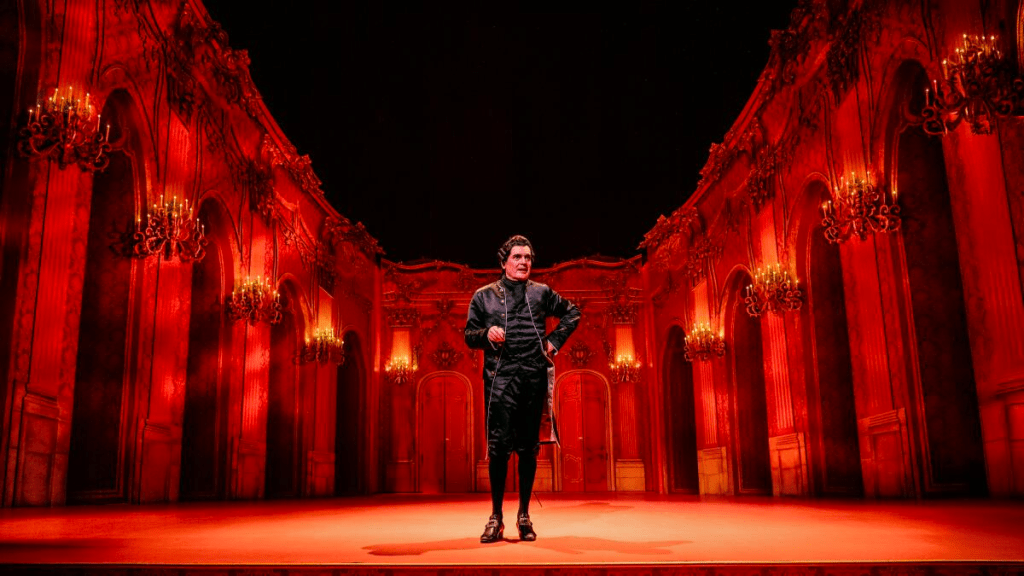
Speaking of inexplicable genius, add Jefferson Mays to that list. His performance as Salieri in Pasadena Playhouse’s production of Amadeus was incredible. Otherworldly. Next level greatness. Easily in my top five stage performances of all-time. (Now he has two in there. This and his one-person performance of A Christmas Carol which I saw twice at the Geffen in 2018.)
Every element of this Pasadena Playhouse production is extraordinary. Some of the best production design across the board that you’ll ever see and the entire ensemble is in top form. But it is Mays’ performance that will leave you scratching your head going, “How in the world did he just pull that off?”
We had a Vs. Tuesday Night Live outing to see the show yesterday. Afterwards, out on the Playhouse courtyard, several people expressed exactly what I was thinking. Not only was Mays’ unreal good, but it’s only Tuesday night and he left everything out on that stage. He still has seven performance remaining this week! SEVEN! How will he pull it off?
Again. Genius. You can’t explain it. You’re just grateful when you encounter it.
“Any film you do, you should treat it like the last film you’re ever gonna make.” Christian Bale
“He’s just one of the 10 greatest film actors ever. And I would just say if you’re going to like create that list of people that are chameleons, people that are really artists, I started doing all this stuff in 1990, which is crazy. And so I met a lot of actors. We had a lot of hosts at Saturday Night Live. I was doing those short films. I got to work with feature actors and I just started noticing that there is a giant gulf between personality actors who kind of operate off their charisma with some real skills and then these like I mean for lack of a better term but like real artists and Bale just wow. Wow! Seeing his process was incredible. I was watching it and I was thinking, “Oh my god, he’s that’s Michael Burry on the screen.” – writer/director, Adam McKay on why he chose Christian Bale to play Michael Burry in The Big Short
The author Michael Lewis tells this fantastic story about Christian Bale and his portrayal of Michael Burry in his podcast, “Against The Rules” (excellent podcast by the way)…
,I could not have told Christian Bale how to do it. That meant Christian Bale figured stuff out that I had that I had not articulated. So, this bothered me because I thought I’m an observant chap. I should have observed whatever it was that he would have needed to play Michael Burry. So, we’re on the the junket and I’m, you know, on stage you know, four or five times with Christian Bale and you sometimes talking about the movie in the book and the story and backstage I have a lot of time to chitchat with him. And I kept badgering. I’m like, “How the hell did you do that?” Because all I knew was what Michael Burry had told me. Michael Burry said, I called him. I said, “What’s going on with the movie?” He goes, he said, Christian Bale visited me. He’s the weirdest guy I’ve ever met.
I said, ‘If Michael Burry is calling you weird. And I said, ‘Well, what was weird about it? He said, he [Bale] just wanted to come for a day. He came in the morning, sat across from me until the evening, did not get up to go to the bathroom and just watched me the whole day and asked me some questions. And then at the end of it, he said, “Could I just, could I have that t-shirt and those shorts cuz I’m going to use those? I’m going to wear those when I play you.” And Wow.
And but I So I went to Christian Bale. I said like what the hell happened in those 12 hours? Like what did you figure out? Because there was something about his body language. It was I couldn’t figure out why he had got him because Michael Barry in his presence you feel this discomfort and Christian Bale had replicated that. And he says to me, I don’t want to talk about it. I really pestered him. And finally he says okay he says it wasn’t that complicated. All you, if you watch him you could see he does. It’s a breathing. He breathes in the wrong places of sentences. Yes! And he says as long and if you do that you get all herky jerky and I had not noticed that the the genius in seeing that was just breathtaking to me and he said to me I told McKay just remind me to breathe in the wrong places and everything else will come .
Genius. You can’t explain it. But you know and feel it when you see it.
I have over 250 half-written blog posts in my draft folder.
I always have intentions to come back and finish them, but rarely do. Mainly because I’m just not in the same headspace as I was when I half-wrote it. And it’s nearly impossible to get back there.
“Acting is living truthfully under imaginary circumstances.” -Sanford Meisner
“The imagination is closer to the actor than real life-more agreeable, more comfortable…The imagination is the ignition key. Without it, nothing else works.” -Stella Adler
“Imagination is more important than knowledge. For knowledge is limited, whereas imagination embraces the entire world, stimulating progress, giving birth to evolution. It is, strictly speaking, a real factor in scientific research.” -Albert Einstein, Cosmic Religion and Other Opinions and Aphorisms
“We are limited only by our imagination and our will to act.” -Ron Garan, NASA astronaut
“The minute the eyes of your heart are enlightened, the minute your imagination gives you the picture of your path, your goal, your aim — it is as good as done.” -David Schwarz, The Magic Of Thinking Big
If the imaginary circumstances of the play don’t inspire you to act boldly, then imagine some others that do.
This applies to anything you’re trying to accomplish in life as well.
P.S. – H/t to my friend Jonas for the great Einstein quote above.
“When you drink water from a cup, it becomes part of you. When water falls on you like rain, it evaporates a few minutes later. Similarly, thoughts can be consumed or dismissed. Is this thought nourishing? Is this feeling something you should drink? Or is it more like getting caught in the rain? You’ll always feel the rain, but you don’t have to drink the rain. You can let the thought pass and in a few moments the sun will return. You don’t have to claim everything you feel.” -James Clear
One way to get rid of a negative thought is to simply thank it.
“Thank you, thought. Moving on.”
For the stubbornly negative ones, just keep saying “Thank you.” Over and over until it passes.
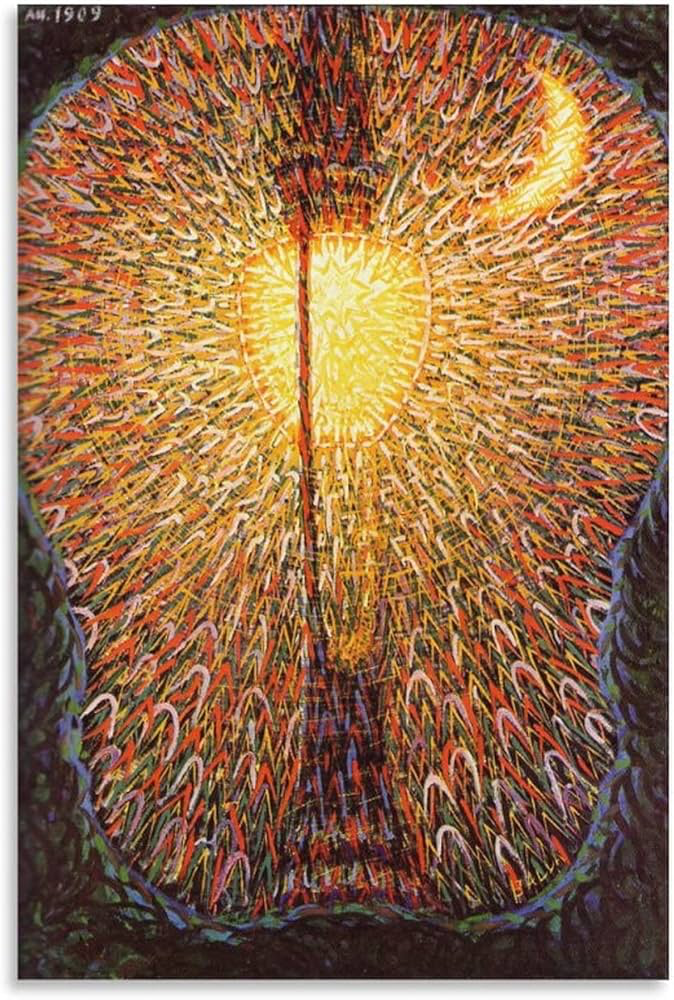
“Street Light” (Lampada ad arco) by Giacomo Balla (1909–1911)
Yes, I do, I love ya I swear on the stars above, I do I swear on the streetlight on the corner Shoving back the shadows One shadow cursing Another shadow laughing Underneath the streetlight I don’t know where they’re coming from I just see ’em passing Underneath the streetlight -song “Underneath The Streetlight” by Joni Mitchell
Some of the greatest, funniest, deepest and most memorable conversations I’ve ever had occurred after seeing a play. Often on a street corner, under the lights. Catching up with a friend, talking about the work you just saw, which then opens the door for everything else.
If you’re looking for yet another reason to go see live theatre, consider this a great one.
P.S. – I just caught up with my good friend Mattie after seeing SYLVIA SYLVIA SYLVIA at the Geffen Playhouse (not out on the corner, but in a parking garage as we walked to our cars). The play is terrific and I highly recommend, but the conversation afterwards was epic.
“If you’re following your calling, the fatigue will be easier to bear, the disappointments will be fuel, the highs will be like nothing you’ve ever felt.” -Phil Knight
How do you know if you’re following your calling?
You look at failures and frustrations as inevitable. As nothing more than mile markers on the journey.
Not as signs that you’re going down the wrong road and should go back the other way.
(And yes, the highs are really, really high. That helps too.)

 The Vs. Studio Blog