Well I don’t know about your right and wrong
I got a muse from the east to the west
All I know is if I never said it before
I’m going to say it with my last breath
I will never forget your healing hands my love
I thought my heart had stopped
I swore I had given up
I will never forget your healing hands my love
You gave me daylight you gave me sunlight -song “Healing Hands” by Citizen Cope
It’s been incredibly heartwarming to see Angelenos coming together to help one another during these fires. I thought to share a beautiful story about the power of art, brotherhood and radical generosity. (Courtesy of George Bothamley and his always excellent “Art Every Day” Substack, I’ve cut and paste it below. You can also read it directly on his site Here. )
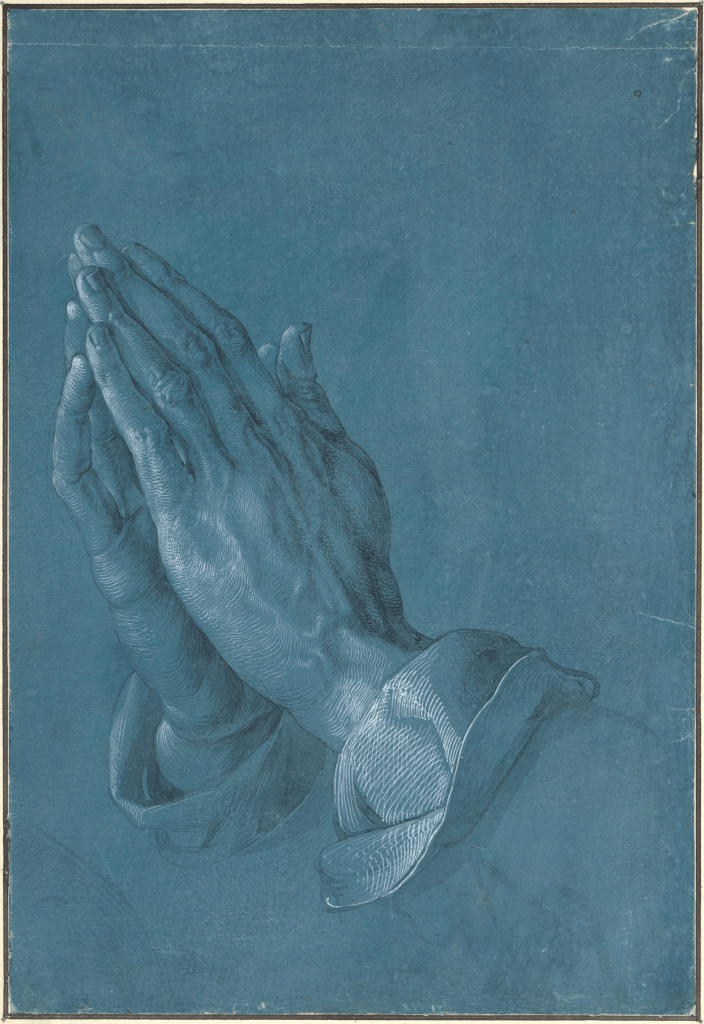
For a long time, Albrecht Dürer’s drawing of these praying hands was interpreted as being kind of self portrait – i.e the artist seems to be depicting his own hands as a symbol of both his spiritual and artistic devotion.
But, actually, the truth about this picture is that the hands actually belong to the artist’s brother – Albert Dürer
And for the real story behind its deeper meaning, we need to briefly go back to when the two brothers were growing up in poverty together; in a small town just outside of Nuremberg.
Albert was the eldest of the two brothers, but they were always very close; and in sharing a mutual love of art, they would spend many happy days together making drawings, or dreaming of becoming professional painters when they grew up.
Back then, the artistic talent in both young boys was undeniable – so, had they been born into a wealthier family, there would have been no question that the two of them would have been sent off to study together in an academy, or for a joint apprenticeship under a master painter in Nuremberg.
But, sadly, the Dürer family were struggling financially at this time due to Albrecht the elder’s business as a goldsmith taking a bit of a down turn.
And in the 15th century – much like now – being an artist was not always the most lucrative field to go into.
So, when the brothers were on the cusp of coming of age, they settled on a little agreement together.
They knew that it could be possible for at least one of them to go on to study art professionally, as long as the other stayed behind to take care of the family.
Thus, in an attempt at the fairest possible way of making this decision, they put their future fate on a coin toss.
Heads for Albert – Tails for Albrecht.
In other words, if the coin landed on heads – then Albert would go off to pursue artistic training in Nuremburg; and the younger Albrecht would instead take a job as a labourer in the local mine, to support to family.
And if it landed on tails . . . then roles would be reversed. Albrecht would go to Nuremburg – Albert would stay behind.
The coin was tossed – and it was the younger brother who came out as the luckier of the two.
Thus, only a few weeks later, Albrecht Dürer was on his way to the city, with a letter of recommendation to become an artist apprentice. And Albert, just as he promised, stayed in the family home . . . taking a job in the local coal mine.
A few years passed – and clearly the result of the brother’s coin toss paid off.
Albert’s work was physically exhausting – but it helped keep the family above the poverty line until business picked up again.
And Albrecht excelled so much in his painting apprenticeship, that he found himself rather unexpectedly set en-route to becoming the most sought after artists in all of Germany.
At only 21 years old – soon after painting the portrait seen below- the young man returned to his home town like a celebrity. But, of course, Albrecht still carried with him a certain amount of guilt about all his success too.
He was deeply aware of just how much of a sacrifice his brother had made for him. And he couldn’t escape the thought that, if a simply coin toss had gone a different way, all of this success would have been Albert’s instead.
So, one evening – when the two brothers finally had some alone time together at their family home – Albrecht said to his brother
“Brother, listen to me. You’ve sacrificed so much for all of us . . . isn’t it time you followed your dream too? You know, I am earning well now. I can provide for everyone quite comfortably. And you don’t have to go back down to those mines anymore. Come with me . . . come to Nuremberg! I’ll help you get started as a painter – and we’ll achieve what we both dreamt about all those years ago together. You will create marvellous things, I’m sure of it!”
But- in spite of his deep gratitude for all that had been said – sadly, Albert could not share his brother’s enthusiasm
“No.” he said “It is not possible. My time has gone now. Albrecht, look at these hands of mine. You see the fingers? In these few years of work, I have broken all of them – multiple times. And you see these scars? These lumps? These marks where my hands have been beaten, bruised, calloused, and crushed by so much stone. You know . . . I can hardly even hold a knife and fork delicately when I eat, such is my loss of feeling in these hands now. So how could I ever hold a paintbrush or pencil?! No, brother. For me . . . it is too late.”
Then, letting go of his brother once more, Albert brought his broken hands together in prayer – saying
“Come. Let’s just pray together – as we used to when we were children. We should be grateful that you have achieved enough for both of us!”
And clearly, this moment is one that Albrecht would never forget; because it is the very thing he captures in his most famous drawing here – sketched over a decade later, when the two brothers were in their mid to late thirties
Technically, it was designed as a “preparatory” sketch for a larger altarpiece commission that the artist was working on at the time (now destroyed).
But in all the tenderness and painstaking care taken over the work here – we can see that, for Albrecht, this drawing is so much more than just a study of hands.
In truth, it is an expression of gratitude instead ; paying tribute to his brother’s sacrifice.
And for that reason, the underlying message of this work is that Albrecht Dürer may have been the artist in practice . . . but nonetheless, his entire career was in fact the result of his brother Albert’s hands too!


What an incredible moving story. Thank you for this
LikeLike
What an incredible moving story. Thank you for this
LikeLike
What an incredible moving story. Thank you for this
LikeLiked by 1 person
You are very welcome!
LikeLike