(b) they love it so much and are so confident in their love of the show, that they’re willing to risk being judged wrong in their assessment.
(c) it’s a generous act; it makes people feel good to know they were a linchpin of sorts; that they told others about your show and those others showed up and also loved it.
Ask yourself when’s the last time you went out on a limb and strongly recommended something to people.
“Today I will be master of my emotions…The tides advance; the tides recede. Winter goes and summer comes. Summer wanes and the cold increases. The sun rises; the sun sets. The moon is full; the moon is black. The birds arrive; the birds depart. Flowers bloom; flowers fade. Seeds are sown; harvests are reaped. All nature is a circle of moods and I am a part of nature and so, like the tides, my moods will rise; my moods will fall…Today I will be master of my emotions…It is one of nature’s tricks, little understood, that each day I awaken with moods that have changed from yesterday. Yesterday’s joy will become today’s sadness; yet today’s sadness will grow into tomorrow’s joy. Inside me is a wheel, constantly turning from sadness to joy, from exultation to depression, from happiness to melancholy. Like the flowers, today’s full bloom of joy will fade and wither into despondency, yet I will remember that as today’s dead flower carries the seed of tomorrow’s bloom so, too, does today’s sadness carry the seed of tomorrow’s joy…Today I will be master of my emotions.” -Og Mandino, book The Greatest Salesman In The World
Joy (Pump, pump, pump it up) and pain (Come on, come on, here we go) Like sunshine (What else? What else?) and rain (Ah yeah, here we go) Joy (Come on, come on, here we go) and pain (Pump, pump, pump, pump it up) Like sunshine (Yeah) and rain -song, “Joy and Pain” by Rob Base & DJ E-Z Rock
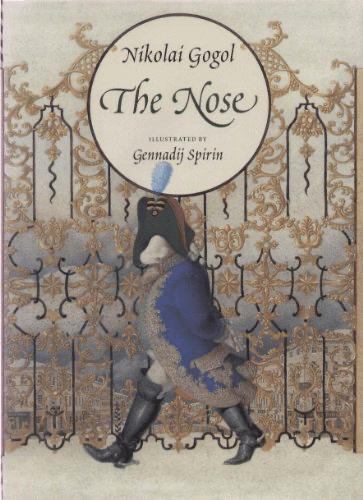
I love the below passage in Nikolai Gogol’s absurdist short story, “The Nose”…
After the police officer had left, the collegiate assessor remained for a few minutes in a sort of indefinable state and only after several minutes recovered the capacity to see and feel: his unexpected joy had made him lose his senses. He carefully took the newly found nose in both his cupped hands and once again examined it thoroughly.
“That’s it, that’s it, all right,” said Major Kovalyov. “Here on the left side is the pimple which swelled up yesterday.” The major very nearly laughed with joy.
But there is nothing enduring in this world, and that is why even joy is not as keen in the moment that follows the first; and a moment later it grows weaker still and finally merges imperceptibly into one’s usual state of mind, just as a ring on the water, made by the fall of a pebble, merges finally into the smooth surface. Kovalyov began to reflect and realized that the whole business was not yet over: the nose was found but it still had to be affixed, put in its proper place.
“And what if it doesn’t stick?”
At this question, addressed to himself, the major turned pale.
One of the many wonderful things about art is its ability to spotlight and heighten moments of joy (and pain). There’s one such moment in the Geffen’s current production of THE BROTHER’S SIZE by Tarell Alvin McCraney (a must see) that’s really stuck with me. The two Size brothers, Ogun and Oshoosi, after much conflict, come together in song (Otis Redding’s “Try A Little Tenderness”). It’s a beautiful, uplifting moment and you wish it could last forever. The heartbreaking thing is that just like life, it can’t.
While it’s sad that joy is fleeting, it reminds us to not hold on to anything. Be in the moment, and then let it pass through you. That way, you can be fully alive and present in the next moment.
Also, remember that while joy is fleeting, so is sorrow. Take comfort in that. Nothing lasts forever. This too shall pass.
P.S. – This scene. Andie, I still maintain that you should’ve chosen Duckie.
P.P.S. – This song for when you need a little boost.
You might be tempted to think that not feeling like doing something indicates you’re on the wrong path.
Don’t fall for the trap.
“Not Feelin’ It” is just another insidious way The Resistance tries to derail your worthwhile efforts.
There are many, many “not feelin’ it” things you have to do in the course of a day, a week, a month, a year, a lifetime, that are in service of something bigger and greater. Including the things you’re passionate about.
Remind yourself of your why. Get back to work. And trust that “feelin’ it” is right around the corner. Because it is.
“Every one of us is shadowed by an illusory person: a false self. We are not very good at recognizing illusions, least of all the ones we cherish about ourselves. Contemplation is not and cannot be a function of this external self. There is an irreducible opposition between the deep transcendent self that awakens only in contemplation, and the superficial, external self which we commonly identify with the first person singular. Our reality, our true self, is hidden in what appears to us to be nothingness….We can rise above this unreality and recover our hidden reality…God Himself begins to live in me not only as my Creator but as my other and true self.” -Thomas Merton, New Seeds Of Contemplation
“There, and you say you are dying! Lie still and get warm, that’s our way…” began Vasili Andreevich.
But to his great surprise he could say no more, for tears came to his eyes and his lower jaw began to quiver rapidly. He stopped speaking and only gulped down the risings in his throat. “Seems I was badly frightened and have gone quite weak,” he thought. But this weakness was not only not unpleasant, but gave him a peculiar joy such as he had never felt before.
“That’s our way!” he said to himself, experiencing a strange and solemn tenderness. He lay like that for a long time, wiping his eyes on the fur of his coat and tucking under his knee the right skirt, which the wind kept turning up.
But he longed so passionately to tell somebody of his joyful condition that he said: “Nikita!”
“It’s comfortable, warm!” came a voice from beneath.
“There, you see, friend, I was going to perish. And you would have been frozen, and I should have…” But again his jaws began to quiver and his eyes to fill with tears, and he could say no more.
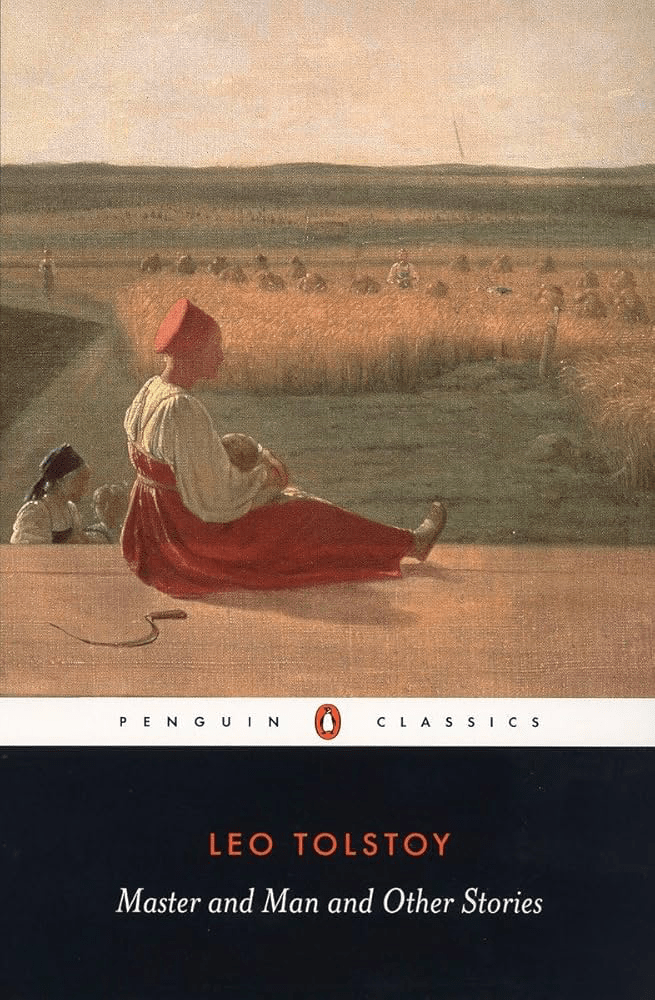
“Well, never mind,” he thought. “I know about myself what I know.” He remained silent and lay like that for a long time.” -excerpt from the shorty story, “Master And Man” by Leo Tolstoy
“We don’t have to become an entirely new person to do better; our view just has to be readjusted, our natural energy turned in the right direction. We don’t have to swear off our powers or repent of who we are or what we like to do or are good at doing. Those are our horses; we just have to hitch them to the right, uh, sled.
What kept Vasili so small all his life? (What is keeping us so small now?) He wasn’t small, actually, as proven by his end. He was infinite. He had access to as much great love as any of our beloved spiritual heroes. Why did he live out his life in that small country of selfishness? What was it that finally jolted him out of it? Well, it was truth. He saw that his idea of himself was untrue. His idea that he was himself was untrue. All of those years, he was only part of himself. He had made that part, was always making it and defending it, with his thoughts and his pride and his desire to win, which continually separated him, Vasili, from everything else. As that entity, Vasili, faded away, what was left behind discerned the fallacy and joined (rejoined) the great non-Vasili of it all.
If we could reverse the process (let him come alive again, warm that body up, melt away the snow, cause him to forget all he’s learned tonight) what we would see would be a mind gradually reasserting a series of lies: “You are separate” and “You are central” and “You are correct” and “Go forth and prove that you are better, that you are the best.
And then he would be all the way himself again.”
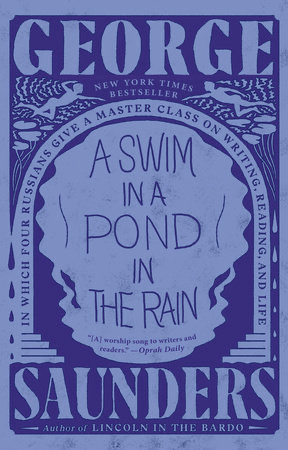
-excerpt from the book, A Swim in a Pond in the Rain: In Which Four Russians Give a Master Class on Writing, Reading, and Life by George Saunders
See the world as your self. Have faith in the way things are. Love the world as your self; then you can care for all things. -“Tao Te Ching” by Lao Tzu (Stephen Mitchell translation)
Another name we can give the “false self” which Thomas Merton and other mystics identified, is the “small self.” The self of scarcity. The self of the singular. The self that’s only concerned with one person: Me, Myself and I. It’s a woefully incomplete and inadequate version.
Instead, see you in everyone and everyone in you. When you do, the whole world opens up. The illusion is shattered. The true self or large “SELF” emerges. The SELF of abundance. The SELF of compassion. The SELF that contain multitudes. The unstoppable SELF.
“Even if we can’t beat fate, we can nevertheless give fortune a hard time.” -Plutarch writing aboutCato The Younger
“A man can be destroyed, but not defeated.” -Ernest Hemingway, The Old Man and The Sea
“I know you had nothing to do with the injustice that brought me to this jail, so I’m willing to stay here until I get out. But I will not, under any circumstances, be treated like a prisoner — because I am not and will never be powerless.” -Rubin “Hurricane” Carter speaking to a prison warden
“The last of the human freedoms: to choose one’s attitude in any given set of circumstances, to choose one’s own way. And there were always choices to make. Every day, every hour, offered the opportunity to make a decision, a decision which determined whether you would or would not submit to those powers which threatened to rob you of your very self, your inner freedom; which determined whether or not you become the plaything to circumstance, renouncing freedom and dignity…” -Viktor Frankl, book Man’s Search For Meaning
Do not go gentle into that good night. Rage, rage against the dying of the light. -Dylan Thomas, poem “Do not go gentle into that good night.”
Regardless of the overwhelming odds, the awful circumstances, and whatever else fate sends your way, you always have a choice about two things:
Your attitude and your response.
No one or no thing can ever take that away from you. Always remember this. For that’s where your true power lies.
If a country is governed wisely, its inhabitants will be content. They enjoy the labor of their hands and don’t waste time inventing labor-saving machines. Since they dearly love their homes, they aren’t interested in travel. There may be a few wagons and boats, but these don’t go anywhere. There may be an arsenal of weapons, but nobody ever uses them. People enjoy their food, take pleasure in being with their families, spend weekends working in their gardens, delight in the doings of the neighborhood. And even though the next country is so close that people can hear its roosters crowing and its dogs barking, they are content to die of old age without ever having gone to see it. -Verse 80 of the “Tao Te Ching” by Lao Tzu (Stephen Mitchell translation)
The closer you can get to narrowing the gulf between those activities you naturally love to do as well as those you have to do, the happier you will be.
One giant clue…your attitude.
Even the most laborious tasks, can you view them differently? Can you find the fun in them? The learning? The growth? Can you flow with them?
Let me take you down ‘Cause I’m going to strawberry fields Nothing is real And nothing to get hung about Strawberry fields forever Strawberry fields forever Strawberry fields forever -song, “Strawberry Fields Forever” by The Beatles
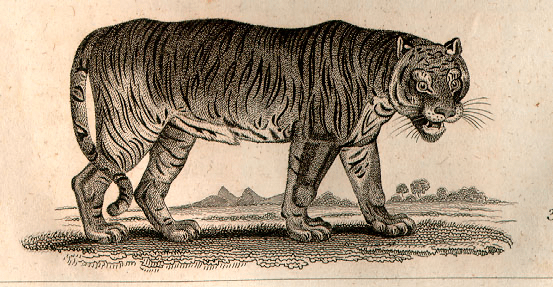
Tyger Tyger, burning bright, In the forests of the night; What immortal hand or eye, Could frame thy fearful symmetry? -poem, “The Tyger” by William Blake
Heading into Labor Day Weekend (unofficially our last weekend of summer), this Zen parable is a reminder to enjoy the strawberries (and maybe even get out and pick some) while you still can (h/t to Sahil Bloom)…
A woman is being chased by a tiger. She runs as fast as she can, but the tiger is catching up. She comes to a cliff and sees some vines hanging over the edge, so she climbs down them, knowing that the tiger will not be able to follow. She looks down and sees another tiger waiting for her if she falls. She looks up at the hungry tiger above and notices a small mouse gnawing away at the vine she is holding onto. She looks ahead and sees a bunch of strawberries in front of her on the cliff face. She picks a strawberry, puts it in her mouth, and enjoys it thoroughly.
The tigers can wait.
Have some fun. Be here now. Enjoy the strawberries.
“Love is the only force capable of transforming an enemy into a friend.” -Dr. Martin Luther King, Jr.
“The transformative power of love is not fully embraced in our society because we often wrongly believe that torment and anguish are our ‘natural’ condition.” -bell hooks
In all that you do, in all your relationships, be transformational. Not transactional.
Wondering how to do so?
Love. (Not the feeling. The active verb.)
When you love, when you “will the good of the other as other” per Aquinas, you can transform everyone you come into contact with.
Dear friends, ask the hard questions. Give thanks for uncertainty. Trust yourself. Lean into the wisdom of community. Don’t take yourself too seriously. Know that the arc is long. Lean on the ancestors. Ask the creatures for advice. Follow the wind. Know that there is no right way. Trust others on their path. Find yours. Embrace the mess. Give your life to a holy, undeniable “Yes!” Whatever that yes may be. And know, that this “had to happen.” How lucky we are to be alive!



 The Vs. Studio Blog