EnCOURAGEment

“You just needed a little encouragement.”— Harold to Phillip in the play Orphans by Lyle Kessler

Honor to those whose words or deeds
Thus help us in our daily needs,
And by their overflow
Raise us from what is low!
-Henry Wadsworth Longfellow, poem Santa Filomena

courage (noun): c. 1300, corage, “heart (as the seat of emotions),” hence “spirit, temperament, state or frame of mind,”from Old French corage “heart, innermost feelings; temper” (12c., Modern French courage), from Vulgar Latin *coraticum (source of Italian coraggio, Spanish coraje), from Latin cor “heart” (from PIE root *kerd- “heart”).

encourage (verb): early 15c., from Old French encoragier “make strong, hearten,” from en- “make, put in” (see en- (1)) + corage “courage, heart” (see courage). Related: Encouraged; encouraging; encouragingly.

Sometimes all a person needs when they’re going through some shit is your attention and your encouragement.

Or really, your heart.

Incentives

“I believe that people generally want to be what we call good. They want to cooperate with people. They don’t want to steal; they don’t want to cheat. But everybody has a price. Everybody has an incentive.” -Stephen J. Dubner, co-author Freakonomics

“Follow the money.” -Deep Throat (played by Hal Holbrook) giving advice to Bob Woodward (played by Robert Redford) in the film All The President’s Men

If you’re looking at human behavior, how systems work, why things are the way they are. If you’re looking to change or make any kind of change in this world…

…I want to say one word to you.

Just one word…

Are you listening?…

…INCENTIVES.

What’s the incentive?

Start there. You figure that out, everything else is cream cheese.

P.S. – This scene from my all-time favorite film.

Trouble

Trouble
Trouble, trouble, trouble, trouble
Trouble been doggin’ my soul
Since the day I was born

Worry
Worry, worry, worry, worry
Worry just will not seem to leave
My mind alone

Trouble
Oh, trouble, trouble, trouble, trouble
Feels like every time I get back on my feet
She come around and knock me down again

Worry
Oh, worry, worry, worry, worry
Sometimes I swear it feels like
This worry is my only friend
-Ray La Montage, song “Trouble”

“What disturbs us in this world is not trouble, but our opposition to trouble.” -Alexander MacLaren

“When she runs into a difficulty, she stops and gives herself to it. She doesn’t cling to her own comfort; thus problems are no problem for her.” -Verse 63 of Tao Te Ching by Lao-Tzu (Stephen Mitchell translation)

If you had to sum up all of Stoicism in a single sentence, it would be this:

You can’t control what happens to you; you can only control your response to it.

So much of our internal angst is caused by worrying about if trouble will come. Or when it does arrive, feeling angry because it’s interfered with our plans or how we think life is “supposed to be.”

Any good producer will tell you that it’s not if trouble will arise in production, it’s when. How you deal with the trouble defines you.

Yes, you prepare the absolute best you can, but unforeseen issues will arise. Have confidence to know that you can deal with them. And that by dealing with them, you will learn and grow and be stronger and better for the next production. (Remember the principle of Amor Fati. The obstacle becomes the way.)

Stephen Mitchell in his Tao Te Ching translation advises us to look at trouble or difficulty “like a letter with your address on it.” Yes! Terrific advice!

L.E.A.P.

“Persistence and endurance will make you omnipotent.” –Casey Neistat

“Action expresses priorities.” -Gandhi

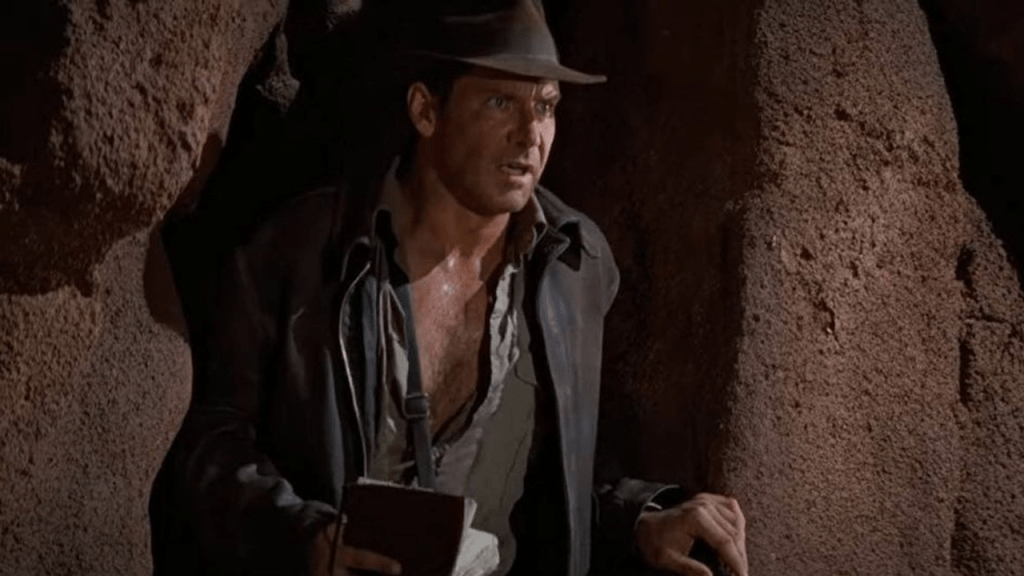
Who doesn’t enjoy a good acronym? Inspired by my favorite action hero (Can you name the movie and scene depicted above?), here’s one for you and it’s the secret sauce to accomplishing anything you care about…

Love what you do. (Notice I didn’t say “do what you love.”)

Strive for Excellence at all times.

Action. Action. Action. Take massive and continuous action. Iterate. Then take more massive and continuous action.

Persist.

P.S. – Remember, deciding to do something like making your art is always, always a leap of faith. But you gotta take the leap.

Love What You Do

Love, love me do
You know I love you
I’ll always be true
So please, love me do
Whoa-oh, love me do
-The Beatles, song “Love Me Do”

“Start where you are. Use what you have. Do what you can.” -Arthur Ashe

Instead of “do what you love” as Confucius once supposedly advised, instead “love what you do.”

As this HBR article points out, most people don’t know what they’re passionate about. Yet so much advice is about finding what you truly love and then going all out towards pursuing that passion. This results in a disconnect and unhappiness because people feel like they’re not doing what they “should be doing” in life. Furthermore, they have no idea what they should be doing. They feel stuck and stagnant.

The good news as the article also points out, is that passion can be developed over time. And it starts with where you are right now. For whatever work you’re doing, whatever you have to do, fully invest yourself in it. Be grateful that you have an opportunity to learn, to serve, to be productive. Continually ask yourself, how you can do things better and make things better for everyone around you.

Trust that you’re not settling either. Have faith that one of two things will happen as a result of your constancy of effort.

You’ll discover you’re actually doing what you love. It was just hiding in plain sight all along and required an attitude shift.

Or.

You’ll get discovered as a linchpin. Linchpins are invaluable. As such, they’re usually the ones who get to do the work they love.

Forty Years?

Picasso was at a Paris market when an admirer approached and asked if he could do a quick sketch on a paper napkin for her.

Picasso politely agreed, promptly created a drawing, and handed back the napkin — but not before asking for a million Francs.

The lady was shocked: “How can you ask for so much? It took you five minutes to draw this!”

“No”, Picasso replied, “It took me 40 years to draw this in five minutes.” -story (probably apocryphal) recounted in the book “What They Don’t Teach You at Harvard Business School” by Mark H. McCormack

“My first novel taught me how to write and it took forever. It took thirty years I think, and when it was done I felt I was a writer. Which was an enormous kind of gratification for me because I hadn’t known this.” -Don DeLillo

“I began writing ‘Matterhorn’ in 1975 and for more than 30 years I kept working on my novel in my spare time, unable to get an agent or publisher to even read the manuscript.” -Karl Malantes, author Matterhorn

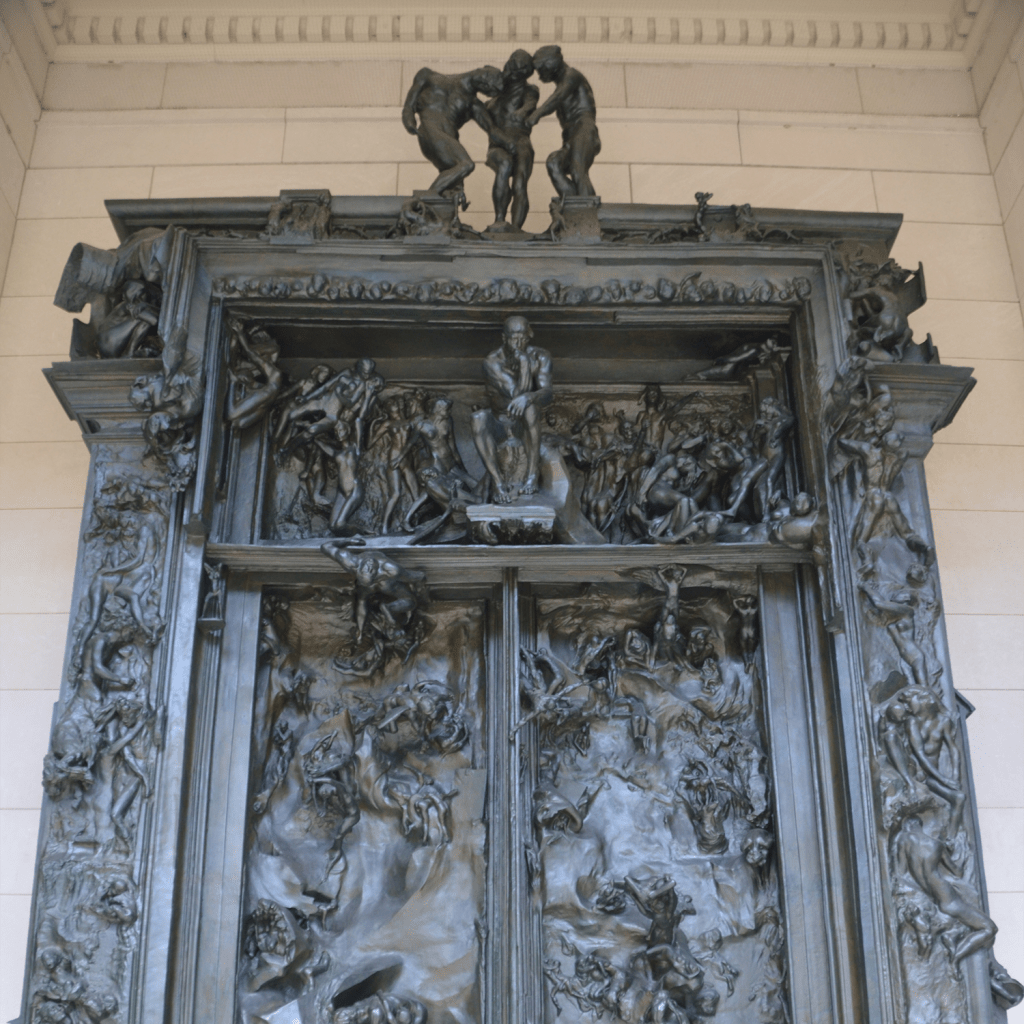
When you’re shooting for greatness, trying to make a masterpiece like Rodin’s “La Porte de ‘l’Enfer” (pictured above and took 37 years to complete), the question isn’t “How long will this take?” But rather, “Can I devote myself to this for how ever long it takes?”

It probably won’t take you forty years…But then again, it might. Keep going.

P.S. – “I’m Picasso!”

Don’t Trust Happiness

“Joy is the happiness that does not depend on what happens.” -Brother David Steindl-rast

“Joy for humans lies in human actions. Human actions: Kindness to others, contempt for the senses, the interrogation of appearances, observations of nature and events in nature.” -Marcus Aurelius, Meditations

In the film Tender Mercies (one of my all-time favorites), Robert Duvall plays Mac Sledge, a down and out country singer who seeks redemption for past mistakes. He meets a young widow, Rosa Lee (played by Tess Harper), and her young boy Sonny (Allen Hubbard). Rosa’s “tender mercies” and love and affection give Mac a second chance. If you haven’t seen the film, it’s a must watch. Duvall’s at the top of his game (deservedly won the Academy Award for Best Actor) as is the rest of the cast. Playwright Horton Foote wrote the screenplay, the music is fantastic (Betty Buckley can absolutely belt out a tune) and the cinematography of Texas is stunningly beautiful.

There’s one scene in particular that gets me every time. I won’t say anything about it so as not to spoil the film, but Mac says to Rosa:

“I don’t trust happiness. Never did. Never will.”

The Stoics would agree. Happiness is a feeling. It’s fleeting at best and entirely dependent on external conditions going your way. How can you trust that?

Instead, we should seek and cultivate joy. For ourselves and others. Joy lasts even when happiness departs. Joy is within our control. It’s an action. Something we do and hold. It’s a continual process of viewing the world through an equananimous lens. Joy is not dependent on feelings to maintain. It lies within.

For all these reasons, we can trust it.

Feel. Then Conceal.

“As Martin Landau described it, Strasberg’s approach to emotion was to ‘find it, express it, then suppress it…find the emotion, and then find a way to allow it out, and then hold it back the way the character would, and if stuff leaks out that’s what’s supposed to happen.” -book, “The Method: How The Twentieth Century Learned To Act” by Isaac Butler

For the actor…

Feel. Then Conceal.

They key here is that you authentically have to feel something before you can conceal it. When you manipulate or go for an emotional result, we in the audience can tell.

Remember, it’s not how you feel up there.

It’s how we (the audience) feel out here.

What If It Does Work?

“You’ll never have that kind of relationship in a world where you’re afraid to take the first step because all you see is every negative thing 10 miles down the road.” -Sean Maguire’s (played by Robin Williams) advice to Will Hunting (played by Matt Damon) in the film Good Will Hunting

Yes, our definition of art is doing something that might not work in service of others.

But what if it does work?

What if it works out better than you could have ever imagined?

What if it changes people’s hearts and minds?

What if it changes the world?

It could.

But how will you know until you try?

Suffering And Compassion

“Suffering is whenever we realize we’re not in control.” -Richard Rohr, The Naked Now: Learning To see As The Mystics See

“Compassion is our capacity to relate in a tender and sympathetic way to what we perceive. Instead of resisting our feelings of fear or grief, we embrace our pain with the kindness of a mother holding her child…Compassion honors our experience; it allows us to be intimate with the life of this moment as it is. Compassion makes our acceptance wholehearted and complete. . .Compassion means to be with, feel with, suffer with. Classical Buddhist texts describe compassion as the quivering of the heart, a visceral tenderness in the face of suffering. In the Buddhist tradition, one who has realized the fullness of compassion and lives from compassion is called a bodhisattva. The bodhisattva’s path and teaching is that when we allow our hearts to be touched by suffering—our own or another’s—our natural compassion flowers. The bodhisattva’s aspiration is simple and powerful: ‘May all circumstances serve to awaken compassion’…To cultivate the tenderness of compassion, we not only stop running from suffering, we deliberately bring our attention to it.” -Richard Rohr, The Naked Now: Learning To see As The Mystics See

“Life is suffering” as the Buddha once said.

But that doesn’t mean we have to suffer alone.

Making and sharing our art engenders empathy for the human condition. It opens our hearts to others suffering. Helps us realize “If not for the grace of God, go I.”

Which then inspires our compassion. Gives us the courage and strength to reach out to another and let them know…”Hey, you’re not alone. I got you. Let’s walk this path of suffering together.”