“It took me twenty years to become an overnight success.” -Eddie Cantor
“I did stand-up comedy for eighteen years. Ten of those years were spent learning, four years were spent refining, and four were spent in wild success.” -Steve Martin
“I start early and I stay late, day after day, year after year, it took me 17 years and 114 days to become an overnight success.” -Lionel Messi (after his debut match with FC Barcelona’s 1st team on October 16, 2004)
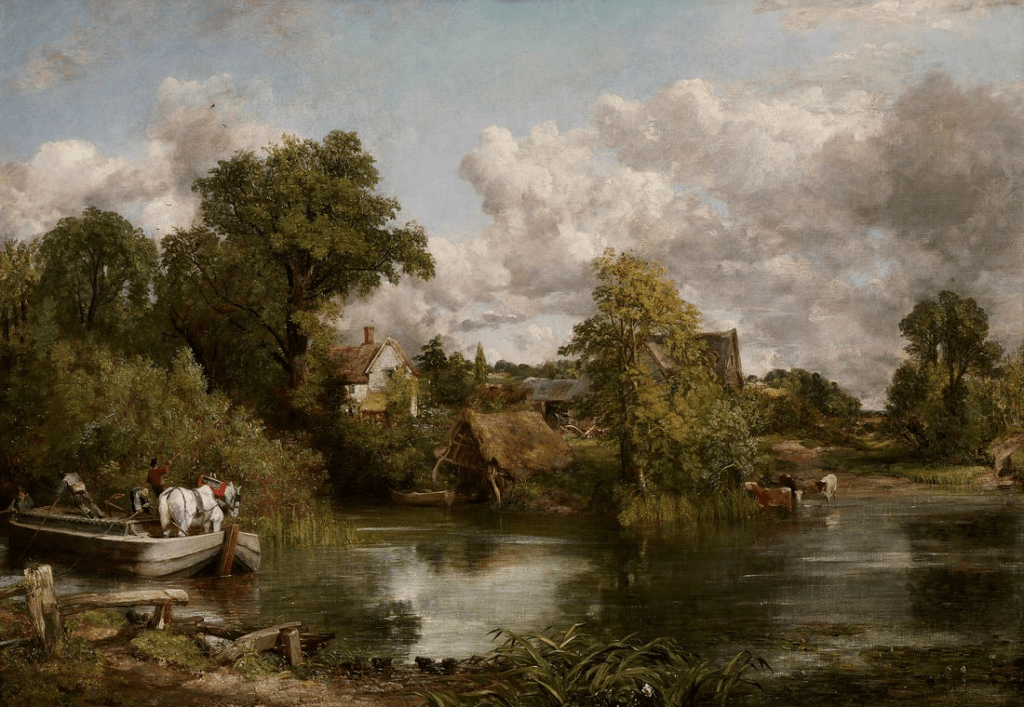
Andrew Bothamley in his wonderful “Art Every Day” Substack, tells the below story about the English painter, John Constable…
John Constable’s name will forever be tied to the English countryside.
With a career almost entirely devoted to depicting the landscape in sunshine, storm, winter, spring, summer and fall (or, indeed, in England’s unique habit for having a mix of all these things in a single day!) . . . the quality that really elevated Constable to being one of England’s greatest ever artist was his ability to paint with such an earthy authenticity.
A strong proponent of “braving the elements”, and painting outdoors – he set a precedent which would later have a massive influence on the ideals of French Impressionism.
And while his most widely famous work is the Iconic “Hay Wain”, which he painted on the banks of the River Stour in 1821 – today, I wanted us to feature one of his earlier Stour Paintings from 1819; because without this work, Constable may well have had a very different fate as an artist.
At the time of painting this work, John Constable was in his early forties and had been a professional artist for just under 20 years. But in all honesty, things were not going all that well.
Financially, he was just about scraping by as a painter of landscapes. Yet, with with every passing year, things were getting more difficult. And increasingly, he was starting to regret a certain decision he had made back in 1802 – when, as a young man, he had turned down quite a lucrative opportunity to become the art teacher at the renowned military college of Sandhurst (then known as Great Marlow College).
At the time, he was convinced that “compromising” with this more secure career path would lead him astray from his single minded “pursuit of truth” as a painter.
But to most people who knew him, this decision was entirely foolhardy. And in fact, a number of his artist peers predicted that “this will be the end of the man”.
Words which, frankly, were starting to seem worryingly prophetic.
Yet still, Constable pushed on with his work. And while knowing that his career as an artist really was becoming a matter of “now or never” – he started making plans for the upcoming Royal Exhibition in 1819.
This was going to be one of his largest works to date -measuring almost six feet in width.
And, frankly, the artist painted with all the intensity of a man who he was determined to go out with a bang if this really was to be his final painting.
But, fortunately, his hard work was about to be rewarded by a change in fortunes.
When the work was finally exhibited publicly. it received high praise; earning Constable a much longed for nomination for associate membership to the Royal Academy.
It was also purchased for a decent sum of 100 Guineas by none other than John Fisher, the Bishop of Salisbury at the time. And soon after this, Bishop Fisher also commissioned the artist to create a second painting too – which led to Constable’s magnificent View of Salisbury Cathedral. (A work we covered here previously)
Thus, after all those decades of hard work, Constable finally became “an overnight success”.
And from the brink of giving up on his career as a painter – he was now about to embark on a series of works which would result in many of his most famous masterpieces.
Although it’s worth mentioning that, for the rest of his life, Constable always remained particularly attached to his White Horse. Hence, in a letter to Bishop Fisher in 1826, the painter said:
“In the life of an artist, there are generally perhaps one, two or three pictures, on which hang more than usual interest.
This is mine”
You never know what will be your “White Horse.” Or if you will ever even have one.
But the only way to find out is to keep going, keep trying, keep making your art.
 The Vs. Studio Blog