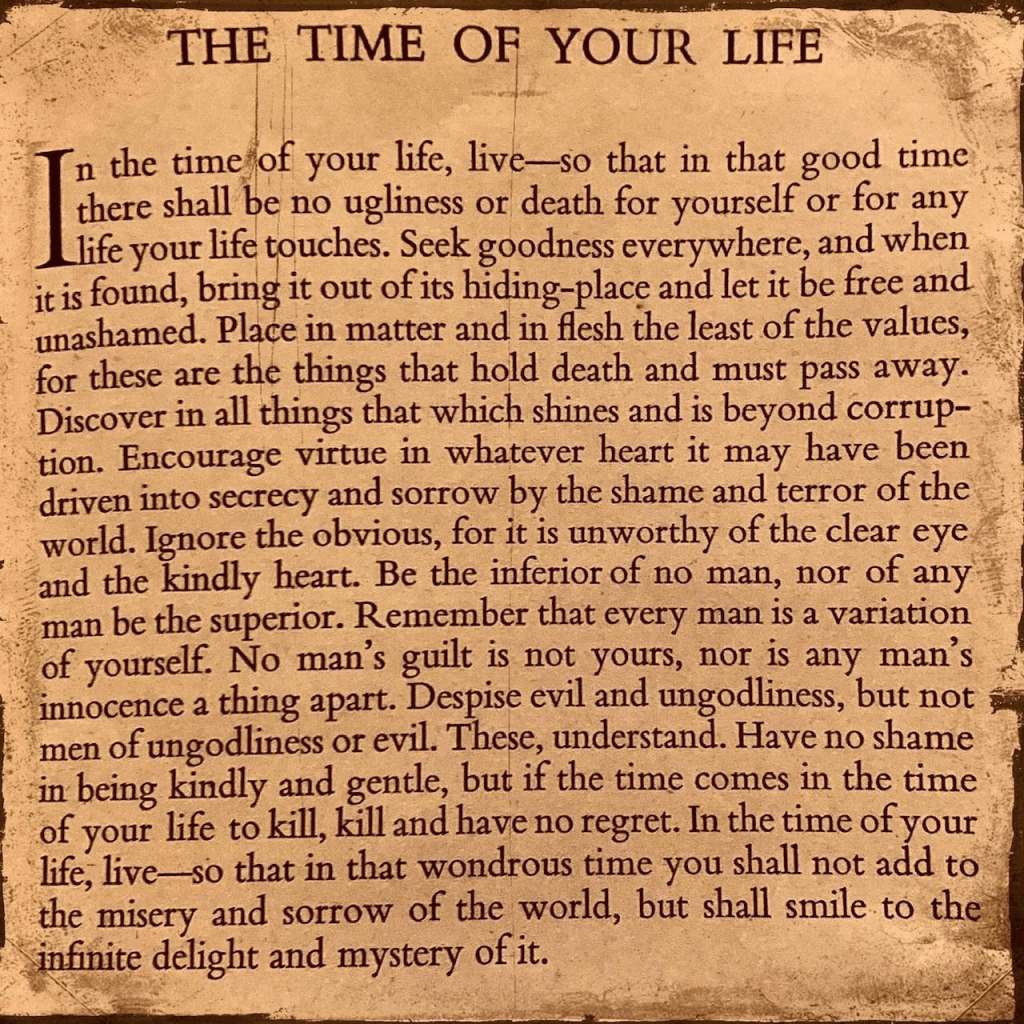
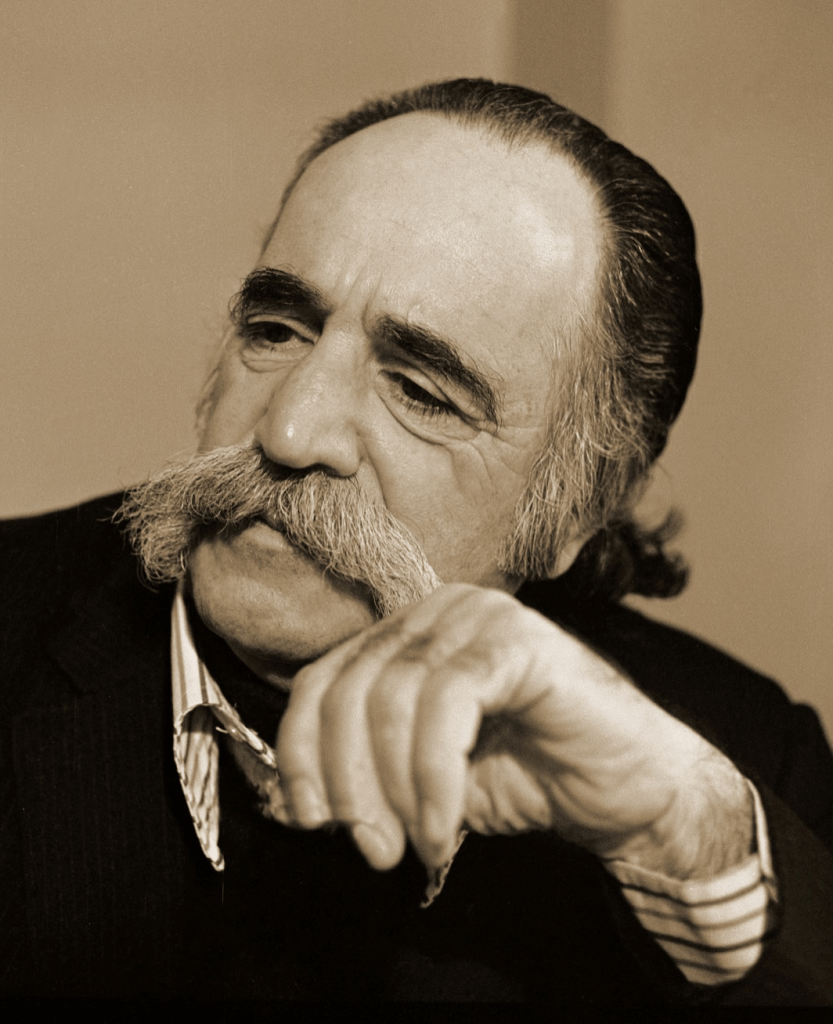
“Do not pay any attention to the rules other people make. Forget Edgar Allan Poe and O. Henry and write the kind of stories you feel like writing. Learn to typewrite, so you can turn out stories as fast as Zane Grey.” -William Saroyan, from his preface in his short story collection, The Daring Young Man on the Flying Trapeze
William Saroyan (born 1908 in Fresno, CA; died 1981) was an Armenian-American novelist, playwright, and short story writer. He won the Pulitzer Prize in 1940 for his play The Time Of Your Life (he refused the award because he believed commerce should not judge the arts), and the Academy Award in 1943 for Best Story for the film The Human Comedy (his original treatment was rejected by the studio, so he turned it into a novel).
Saroyan wrote extensively about the Armenian immigrant life in California. Many of his stories and plays are set in his native Fresno. He grew up very poor, including spending five years in an orphanage starting at age three. (He was later reunited with his family in Fresno when he was eight.) In his short story collection, My Name Is Aram, Saroyan called his childhood “the most amazing and comical poverty in the world.” As a young man, he worked a variety of odd jobs and traveled extensively throughout the San Joaquin Valley, and much of his early writing reflects this experience.
Besides his talent, Saroyan was known for his blazing speed and prodigious output of work (sadly later in his life, also known for his heavy drinking and gambling). He’s written nine novels, fifteen short story collections, nearly forty plays and over a dozen essays and memoirs. He famously wrote The Time Of Your Life in six days at New York’s Great Northern Hotel. Although in an interview Saroyan said, ‘You can’t just say I wrote this play in six days and let it go at that. It really means six days – and 30 years.”
Saroyan is regarded as one of the most underrated literary figures of the 20th century. Kurt Vonnegut called him “the first and still the greatest of all the American minimalists.”

”Most writers strain too hard to produce, especially in the movies. Since all art consists of capturing and presenting a section of life, why should characters and plots be forced?” -William Saroyan
Following on the heels of his successful debut play, My Heart’s in the Highlands (produced by the Group Theatre), The Time Of Your Life opened in October, 1939, at The Booth Theatre on Broadway. (Saroyan actually directed the production after seeing early rehearsals in New Haven. He dismissed that director and completely restaged it for Broadway.) It was an instant success and immediately entered the canon of great American plays. Besides winning the Pulitzer, The Time Of Your Life also won the New York Drama Critics’ Circle award, becoming the first play to win both. It’s been revived three times on Broadway; was made into a film in 1948, starring James Cagney; and twice filmed for TV. The Royal Shakespeare did a star-studded production in 1983 and in 2002, Steppenwolf Theatre under the direction of Tina Landau, did a much heralded revival.
Set in a San Francisco waterfront bar called Nick’s Tavern (based on a real place Saroyan frequented called Izzy’s), The Time Of Your Life offers a rich tapestry of human life. Wistful dreamers, hobo-cowboy fabulists, pining lonely hearts, and beer-hall-philosophers are among many other eccentrics who all populate Nick’s. There is “much humor, a touch of menace, and a refrain of despair. No foundation. All the way down the line.” as The New York Times wrote.
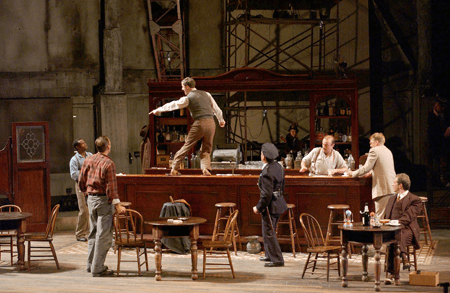
“What I love about it is that it fluctuates between these two extremes which are the nitty, gritty reality of street life and money and cold places and no shoes and the word which appears in more thirties songs that any other word, which is dream. There are so many songs about the dream. And Joe’s first line to Kitty, which is “What’s the dream?” That line is very mysterious to me. And the more I think about the play and because I’ve been listening to and playing through a lot of music of the period, I’ve realized the dream, with a capital T and a capital D is a big thing. So I love, I love, there’s this Oscar Wilde quote, and I’m going to misquote it, but it’s something like, “We are all in the gutter, but some of us are looking at the stars,” but it’s that pull of opposites, which is also what we’re trying to follow through in the designs, which is on the one hand a kind of really exposed, raw, human, prosaic word, and a world that romance and a belief in a better future and I think Saroyan does that too, in that on the one hand he’s looking at a group of people who are, you know, one could consider to be the down-and-outers, the disenfranchised, the, it’s a motley crew. And at the same time they’re filled with these incredible longings for what is good and beautiful and true and that’s what I find in his writing, is this great mixture of the hardships of reality and the beauty of the dream.” -Tina Landau
Join us tonight on Zoom for a Vs. Tuesday Night Reading of this American masterpiece.
 The Vs. Studio Blog